Tag: china manufacturing

  • Why Most Amazon Sellers Fail When Sourcing Products from China

    Hard truths from someone who works inside the supply chain every day.

    Every week, thousands of new Amazon sellers rush into China sourcing thinking it’s “easy”:
    Find a product → Buy from Alibaba → Ship to FBA → Profit.

    Reality?
    Most lose money.
    Some lose their entire business.
    A few never even launch.

    This article explains why—and how to avoid the traps that wipe out new sellers every day.


    1. Over-Relying on Alibaba (and Treating It Like Amazon)

    Most failed sellers start their sourcing journey on Alibaba—and never leave it.

    The mistake isn’t using Alibaba.
    The mistake is depending on Alibaba as the only source of truth.

    Problems include:

    • Taking listings at face value
    • Believing “Gold Supplier” = trustworthy manufacturer
    • Assuming photos = real factory
    • Chasing the lowest price
    • Thinking Alibaba is a wholesale version of Amazon

    It’s not.

    Alibaba is a giant directory with good suppliers, average suppliers, middlemen, and scammers living together.

    Real-Pro World

    Professionals treat Alibaba as a starting point, not a sourcing strategy:

    • Verify outside Alibaba
    • Cross-check supplier identity
    • Request business licenses
    • Audit manufacturing capability
    • Get samples from multiple sources

    If you build your entire business on one platform, your business has no legs.


    2. Lack of Quality Control (QC) Knowledge

    Many Amazon sellers don’t understand QC at all.
    Worse, they think QC = “Ask the supplier to check before shipping.”

    That’s not QC.
    That’s wishful thinking.

    What actually happens without QC:

    • Wrong materials
    • Incorrect colors
    • Weak stitching
    • Defects that fail Amazon inspection
    • FBA warehouse rejecting your shipment
    • Refunds → bad reviews → ranking death

    Amazon customers judge you in 3 seconds after opening the product.
    There is no second chance.

    Pro Tip

    QC must happen during production, not after.

    Professionals use:

    • Pre-production sample confirmation
    • On-line inspection (during production)
    • AQL inspections before packaging
    • Final pre-shipment inspection

    If you aren’t checking quality, your customers will check it for you—with 1-star reviews.


    3. No Pre-Shipment Inspection (The Most Fatal Mistake)

    This is the #1 reason Amazon sellers fail sourcing from China.

    Many skip inspection because:

    • “I trust the factory.”
    • “We worked together once.”
    • “I need to save money.”
    • “The factory said everything is fine.”

    Skipping inspection is like shipping a product blindfolded.

    Real-world consequences:

    • 20% defects
    • Wrong labeling → FBA rejects shipment
    • Wrong packaging → Amazon suspends listing
    • Product fails safety requirements
    • “This is not as described” complaints
    • Expensive returns and refunds

    A $150–$300 inspection can save a $10,000 order.

    Professionals never ship without inspection.
    Beginners almost always do.


    4. Blindly Following Hot Products (The Guru Trap)

    Many failed sellers choose products because a YouTuber said:

    “This is a trending 7-figure product—just launch it!”

    The truth?
    If it’s on YouTube, it’s already saturated.

    The “hot products” ecosystem destroys new sellers because:

    • Products are hyper-competitive
    • Margins collapse within weeks
    • Everyone uses the same supplier
    • Listings become 100% identical
    • Reviews are dominated by older sellers
    • Cost rises as demand spikes

    Real-Pro Approach

    Don’t choose a product because of hype.
    Choose it because of:

    • Differentiation potential
    • Manufacturing complexity
    • Real value-add possibilities
    • Supplier strengths
    • Stable long-term demand

    If everyone else can copy your product overnight, you don’t have a business—you have a lottery ticket.


    5. Not Understanding MOQ (Minimum Order Quantity)

    Many Amazon sellers treat MOQ as a negotiation fight:

    “I only want 50 pcs. Why can’t the factory accept?”
    “I want to test the market first.”

    Factories aren’t being difficult.
    They have unavoidable costs:

    • Mold setup
    • Machine startup
    • Workers scheduling
    • Material minimum purchase
    • Packaging MOQ from their suppliers

    What failed sellers misunderstand:

    • Low MOQ = higher unit cost
    • Very low MOQ = trading company reselling someone else’s stock
    • Low MOQ often means zero customization
    • Low MOQ increases defective risk

    Real-Pro Strategy

    Professionals don’t “fight” MOQ.

    They negotiate structure:

    • Use existing materials
    • Reduce color variations
    • Accept neutral packaging
    • Produce in batches
    • Share materials with other orders

    This is how you get low risk, low quantity, and stable quality—without begging.


    6. Failing to Manage Suppliers (This Is a Relationship Business)

    Amazon sellers who fail usually treat suppliers like vending machines:

    “You give price. I pay. You ship.”

    China’s supply chain doesn’t work like that.

    Manufacturing involves:

    • Constant communication
    • Technical clarifications
    • Pack-out details
    • Labeling requirements
    • Quality checkpoints
    • Timeline management
    • Daily adjustments

    When sellers don’t manage suppliers:

    • Production delays go unnoticed
    • Material substitutions happen silently
    • Packaging changes happen last minute
    • Shipment deadlines get missed
    • Quality drops because no one is watching
    • Suppliers prioritize better clients

    Real-Pro Approach

    Professionals:

    • Follow up weekly (minimum)
    • Keep everything documented
    • Approve every change
    • Maintain clear expectations
    • Track production milestones
    • Build long-term trust

    Good management reduces risk more than any tool or inspection.


    Conclusion

    Most Amazon sellers fail not because China sourcing is hard—but because they approach it casually.

    Success requires:

    • Verification
    • Quality control
    • Real sourcing strategy
    • Supplier management
    • Understanding of manufacturing logic
    • Long-term thinking

    Do these well, and you’ll outperform 90% of the sellers who burn out each year.
  • Alibaba Scams 2025: The 4 Most Common Traps (And How to Avoid Them)

    Alibaba remains one of the biggest sourcing platforms in the world — but it is not a shopping site.
    It’s a marketplace where honest suppliers and questionable players coexist.

    In 2024–2025, scam cases reported by global buyers increased sharply.
    Why?

    • Economic downturn made many traders desperate to close deals
    • Platform operation costs increased, pushing some sellers to use misleading tactics
    • New buyers rely too much on price and too little on verification
    • More “pretend factories” and agency accounts operating without transparency

    After working 10+ years in sourcing and helping clients across the US, Europe, and Africa, I’ve summarized the 4 most common traps new buyers fall into — and how to avoid them completely.


    1. Scam #1: The “Low-Ball Price” Trap

    This is the most common strategy both on Alibaba and in China domestic platforms.

    How it works

    • A seller uploads the photo of a full product
    • But the displayed price is actually for a single part, accessory, or packaging
    • When buyers click in, they find the real price is similar to market price
    • The low price exists purely to attract clicks and rank higher

    Why buyers fall for it

    Because the platform UI makes it look like the whole product is that cheap.

    How to avoid it

    • Don’t chase “too good to be true” prices
    • Read every word carefully in the price breakdown
    • Compare with market price — if it’s half price, it’s a trap
    • Immediately eliminate sellers using misleading pricing

    This trap wastes time, but rarely causes financial loss — unless you ignore the signals.


    2. Scam #2: Stolen Photos / Counterfeit Products

    This category is extremely common, especially for products with strong brand premium or crowdfunded items.

    Two types of sellers you will encounter

    ① Semi-transparent counterfeit sellers (“crowdfunding version” / “replica”)

    These sellers:

    • Use original product photos
    • List prices far below the official market price
    • Admit that they produce “crowdfunding version”, “private version”, or “replica”

    They are not pretending to be the official brand, but buyers often misunderstand.

    ② High-risk sellers who send actual fake goods

    These sellers:

    • Use the licensed brand’s product images
    • Claim products are original
    • Ship counterfeit goods
    • Buyers only realize after the products arrive

    This is the majority of fraudulent cases.

    How to avoid it

    • Don’t buy branded products from unknown Alibaba shops
    • Ask for real-time photos with today’s date written on a piece of paper
    • If it’s a brand-name product, request authorization
    • Compare prices with official market retail
    • If it’s 30–70% lower than the real price → 99% is fake

    3. Scam #3: Good Sample, Bad Bulk

    This is the trick that hurts new importers the most.

    How it works

    • Seller makes an excellent sample
    • After you pay the deposit and start mass production, quality drops significantly
    • Without inspection, buyers only discover problems when goods arrive
    • Some buyers lose the entire season because of this

    How to avoid it

    • For first bulk order, always do a pre-shipment inspection
    • Check: dimensions, weight, printing, stitching, material, assembly
    • If goods do not match the approved sample →
      Refuse to pay the balance, even if you lose the deposit
    • Never skip inspection just to “save a little money”

    A skipped inspection can cost you an entire business.


    4. Scam #4: Fake Factories (“Pretend Manufacturers”)

    This is one of the hardest scams even professionals sometimes mistake.

    Why it’s hard to detect

    • 90% of Alibaba “manufacturers” are actually traders using factory accounts
    • Factory address is borrowed
    • Workshop photos are stolen
    • Videos are shot in someone else’s factory
    • They know exactly what buyers want to hear

    Even experienced buyers can be misled.

    Why new buyers get trapped

    Because they insist on:

    • “I want the factory directly”
    • “Factory equals lower price”
    • “Trading company must be bad”

    This mindset is dangerous and not aligned with real supply chain dynamics.

    The truth

    Some products are NOT suitable for direct factory sourcing.

    The best supplier is:

    • Responsive
    • Transparent
    • Quality stable
    • Price acceptable
    • Able to follow instructions

    —not necessarily a factory.

    How to avoid this trap

    • Don’t obsess over “factory direct”; know your product category
    • Hire someone to visit the supplier
    • Require real-time factory video calls
    • If you detect dishonesty → withdraw immediately
    • Remember: Alibaba is not Amazon or Costco

    Alibaba is not a shopping platform — it’s a sourcing battlefield.


    Final Advice from a Real Sourcing Professional

    Sourcing from China requires:

    • Time
    • Experience
    • On-site verification
    • Clear specifications
    • Continuous communication

    Alibaba is not a pure marketplace of good suppliers.
    It’s a mix — and you must know how to navigate it.

    If you prefer to avoid scams, inspections, verification, or shipping risks, you don’t have to do it alone.


    Work With Us

    Want safe sourcing, verified suppliers, and on-time delivery?
    👉 Start Your Project

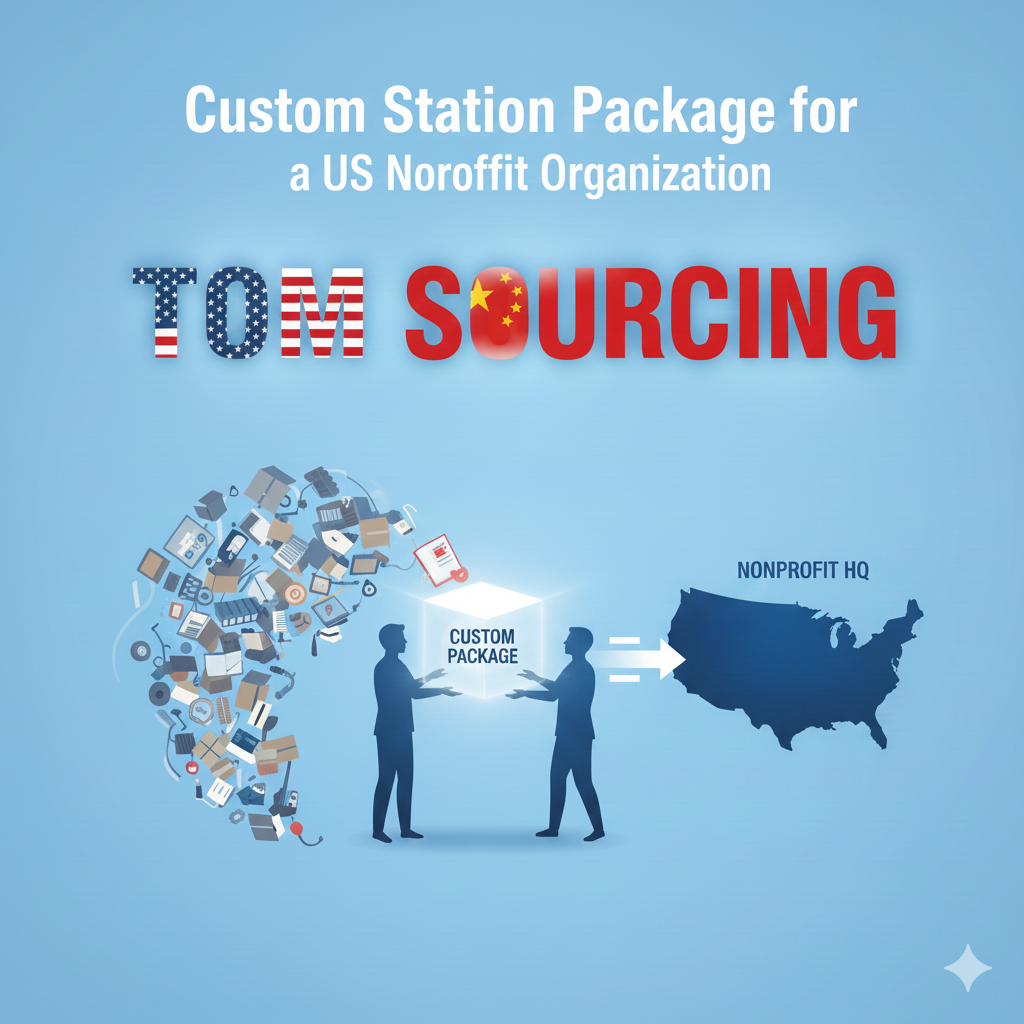
  • Custom Station Package for a US Nonprofit Organization

    Custom Station Package for a US Nonprofit Organization

    Client Background

    Industry: Nonprofit Organization
    Country: United States

    A U.S.-based nonprofit organization wanted to create a custom “station package” to give away during community events.
    The package included:

    • A custom tote bag printed with their logo and website
    • A notebook, accordion file, business card case, and zip pouch, all branded consistently.
      They needed a turnkey solution — from design to final packaging and delivery — within a tight year-end schedule.

    Challenges

    1. Small MOQ across multiple custom-made items.
    2. The tote bag had no drawings, only a hand sketch and a few reference photos — full product development was required.
    3. The notebook design and logo printing also needed custom sampling.
    4. Each set had to be accurately packed with five different products following the client’s warehouse intake standard (carton size, barcode, ASN code, and label).
    5. Production coincided with the year-end factory rush and uncertain US–China trade conditions after policy changes.

    What We Did

    1. Developed and refined the tote bag and notebook after two rounds of sampling.
    2. Worked closely with the client to confirm packing standards, carton specifications, and inbound codes required by their U.S. fulfillment center.
    3. Sourced all five products from trusted suppliers and consolidated them at our Shanghai warehouse.
    4. Inspected all incoming goods, arranged temporary workers to assemble and pack each station package.
    5. Identified and replaced any missing or defective items immediately to ensure perfect sets.
    6. When the trade situation escalated, we provided one month of free storage and low-cost warehouse service until tariffs were lifted — then shipped promptly once the route reopened.

    Outcome

    ✅ 350 sets successfully delivered to the client’s U.S. warehouse
    ✅ 100% passed inspection and fulfilled all inbound standards
    ✅ Client highly satisfied and placed a repeat order of 500 sets the following year


    Work With Us

    Want to make your custom product ideas come to life — smoothly, reliably, and without surprises?
    👉 Start Your Project

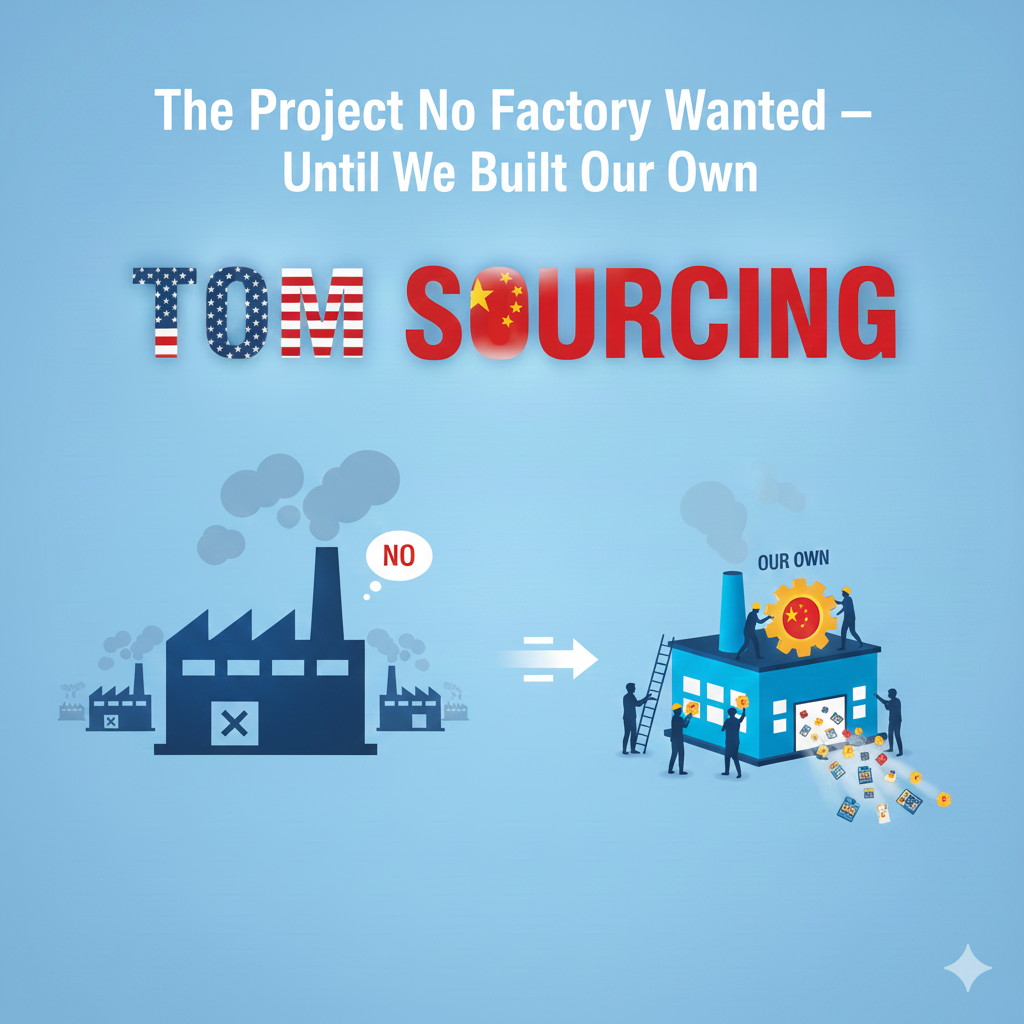
  • The Project No Factory Wanted — Until We Built Our Own

    The Project No Factory Wanted — Until We Built Our Own

    How Tom Sourcing Turned an “Impossible” Sewing Machine Project Into a Market Success

    When people talk about sourcing from China, they picture smooth communication, stable production, and suppliers lining up for orders. Reality is messier. Some projects—especially those involving multiple materials, tight tolerances, and no existing production line—are “factory nightmares” that no manufacturer wants to touch.

    This is the story of one such project.
    A sewing machine nobody wanted to produce.
    A project rejected again and again across Jiangsu, Zhejiang, and Guangdong.
    A project my former U.S. employer thought was “dead.”

    But it became one of my earliest victories—and later, a defining case study for Tom Sourcing.


    1. The Request That Looked Simple—But Wasn’t

    The U.S. company we worked for back then wanted to launch a custom-designed sewing machine for DIY creators: lightweight, safer for beginners, and with a unique stitch function.

    Simple on paper.
    A nightmare in reality.

    Most factories immediately asked:

    • “What’s your annual quantity?”
    • “How many models?”
    • “Who will pay for the new tooling?”

    When they heard the real numbers—initial 500 units, custom electronics, custom plastic housings, custom metal parts—they politely responded:

    “Not suitable for us.”

    Factories prefer predictable, stable, mass-volume projects.
    This sewing machine required:

    • Plastic injection molds
    • Metal stamping
    • Motors
    • PCBA
    • Tooling investment without guaranteed volume
    • Specialized assembly line setup

    For them, too much risk. Too little return.

    But as sourcing manager, it was my job to find a path—if not through a factory, then around the entire system.


    2. Mapping Out a Supply Chain That Didn’t Exist Yet

    Since no single factory wanted the whole project, I developed a multi-supplier plan:

    • Electronics + PCBA: Shenzhen
    • Motor + mechanical assembly: Changzhou
    • Plastic housing: Ningbo
    • Metal internal parts: Suzhou
    • Packaging: Shanghai
    • Final assembly: TBD—because no one would do it

    Instead of asking one factory to take everything, I broke it down piece by piece.
    This reduced risk for suppliers and increased our flexibility.

    But one problem remained: final assembly.

    No factory wanted to build a custom sewing machine from scratch.
    They didn’t have a line, and they didn’t want to change their workflow.

    So we made a bold decision.


    3. Building Our Own Small Assembly Line

    We rented a small workshop space.
    We brought in workers.
    We wrote our own SOPs for:

    • Assembly
    • Testing
    • Needle safety alignment
    • Motor torque calibration
    • Threading inspection
    • Drop test for packaging durability

    I coordinated everything:

    • Designed the workflow
    • Hired temporary labor
    • Managed quality checks
    • Tracked incoming materials
    • Built the first 100 units by hand—with the team

    It wasn’t glamorous.
    But it worked.

    And suddenly, something interesting happened.


    4. When You Build It, the Factories Come to You

    Once suppliers saw:

    • Real samples
    • Real testing equipment
    • A real workflow
    • A real purchase order

    Attitudes changed.

    Factories that said “不行” (not possible) a month earlier now said:

    • “Maybe we can take over assembly.”
    • “We can open a small line for you.”
    • “Let’s discuss long-term cooperation.”

    Why?

    Because in China manufacturing:

    Factories don’t like ideas.
    Factories like evidence.

    Once we created a feasible product—even by ourselves—the risk for suppliers dropped.
    They could see the structure.
    They could calculate costs.
    They could forecast volume.

    By the second production run, we already had two factories bidding to take over our assembly line.


    5. The Turning Point: Scaling the Production

    We ran full inspections on the first 500 units:

    • Load testing
    • Motor burn-in testing
    • Needle safety checks
    • Double QC for PCB stability
    • Packaging carton drop tests
    • Final functionality tests across all stitch modes

    Return rate after launch?
    Under 2%.

    For a brand-new electromechanical product, that was a huge win.

    And because we now had a proven product and stable demand, suppliers became motivated:

    • Tooling upgrades
    • Better packaging
    • Faster lead times
    • Lower MOQ
    • Lower labor cost
    • Higher consistency

    The project went from “nobody wants it” to “everyone wants it.”


    6. What This Project Means for Tom Sourcing Today

    This early experience shaped the DNA of Tom Sourcing.

    Today, we operate with:

    • A real office
    • Our own warehouse
    • The ability to hire temporary workers for assembly, labeling, repacking, and QC
    • 5 years of operating history
    • Import-export license
    • Full product development-to-shipment capability

    And most importantly:

    We don’t rely on suppliers to “believe” in a project.
    We make the project believable through engineering, samples, and execution.

    Sometimes a supplier says, “This project is too small.”
    Sometimes they say, “Too difficult.”
    Sometimes they say, “No existing line.”

    But if we believe the customer has a real market opportunity—

    we build the line, the system, or the sample ourselves.
    Just like the sewing machine project.

    That’s the TOM SOURCING difference.


    7. The Final Result

    Within 12 months, the project:

    • Secured two competing suppliers
    • Reduced unit cost by 18%
    • Improved QC consistency
    • Expanded into two new color variants
    • Hit a reorder cycle every quarter

    A project “no factory wanted” became one of the brand’s flagship products—sold in the U.S. and Europe.

    And yes—this case is absolutely suitable to be presented as a Tom Sourcing success story.

    Because the skills, mindset, and execution that made it possible
    are the same engines powering our company today.