Tag: sourcing agent China

  • When Your China Supplier Goes Dark: Why Your Legal Options Depend Entirely on Who Signed the Contract

    When Your China Supplier Goes Dark: Why Your Legal Options Depend Entirely on Who Signed the Contract

    We’re currently preparing to take a supplier to court in China.

    The amount in dispute is modest — around $1,000 USD. The evidence is solid: a signed contract, a complete WeChat conversation history, clear breach of delivery terms. In Chinese court, with a properly registered Chinese entity filing the claim, this is straightforward. No lawyer required. Walk in with the contract, file the claim, let the process run.

    We’ll likely win. And we’ll get our client’s money back.

    Now here’s the question worth sitting with: what would happen if our client had gone directly to this supplier themselves?


    How This Started

    A long-term client of ours ran into a supply chain problem last year. One of their suppliers — a company we had vetted and worked with for years — developed cash flow problems and couldn’t fulfill an order. We caught this early, warned the client, recovered the advance payment, and sourced several alternative products for their consideration.

    The client wanted the original product. The exact model. Nothing else.

    So they went to Alibaba themselves and found a trading company they had worked with briefly years ago. The owner — we’ll call him Mike — claimed he could supply it. The client asked us to manage the relationship and handle the order on their behalf.

    We signed a purchase contract with Mike’s company. We paid a deposit. We waited.

    The delivery date passed. Then another. Mike’s responses became evasive, circular, and then essentially meaningless — the same message repeated in different words: keep waiting.

    Out of curiosity, we contacted the actual factory we knew supplied this type of product. They confirmed Mike was sourcing from them. They also confirmed they couldn’t deliver yet. We didn’t tell Mike we knew this. We simply asked for our deposit back.

    What followed was a masterclass in bad-faith stonewalling. Non-answers. Deflection. The same instruction on repeat: wait.

    We stopped waiting. We’re going to court.


    The Math That Kills Most Claims Before They Start

    Here’s where this story becomes relevant to every overseas buyer who has ever lost money to a Chinese supplier.

    If you are a foreign company — US, UK, Australian, European — and you need to pursue legal action against a supplier in China, the process looks like this:

    Foreign lawyers cannot appear in Chinese courts. You must retain a Chinese-licensed attorney, preferably bilingual with cross-border experience. And the fees, as of 2026 in Shanghai and Beijing, start here:

    • Small claims (under 500,000 RMB / ~$70,000 USD): 15,000–30,000 RMB (~$2,100–$4,200 USD) in attorney fees
    • Standard commercial disputes: 30,000–80,000 RMB (~$4,400–$12,000 USD)
    • Complex cross-border cargo disputes: 50,000 RMB and up (~$7,400 USD)
    • Bilingual attorney with cross-border experience: 80,000 RMB and up (~$12,000 USD)
    • Hourly rates at premium firms: 2,000–5,000 RMB per hour, five-hour minimum (~$300-750 USD per hour)

    For a $1,000 dispute, the attorney fee alone would cost more than twice the claim. For a $5,000 dispute, you’re still looking at legal fees that exceed what you lost.

    This is the reality for the vast majority of overseas buyers sourcing from China. Most orders fall well below $70,000 USD. Which means most disputes, by the time legal costs are factored in, are simply not worth pursuing.

    The supplier knows this. Some of them are counting on it.


    The Structural Problem With Freelancers and Unregistered Agents

    Many overseas buyers — particularly those new to China sourcing — work with individual freelancers or informal agents. Someone they found online, recommended through a forum, or hired through a platform. Someone with good English, strong communication, and a convincing knowledge of Chinese manufacturing.

    Here’s the problem no one talks about clearly enough:

    If a dispute arises between you and a Chinese supplier, and your only representative in China is a freelancer with no legal entity, that person cannot help you in any meaningful way. They have no standing to file a claim. They cannot appear in court on your behalf. They cannot sign a purchase contract that gives you enforceable rights under Chinese law.

    They can send emails. They can make calls. They can express frustration on your behalf. That’s the limit.

    If your contract is between your overseas company and the Chinese supplier directly, you are a foreign entity pursuing a claim in a Chinese court. See the fee schedule above.


    How the Right Structure Changes Everything

    This is why the legal structure of your sourcing relationship matters as much as anything else.

    When Tom Sourcing manages a procurement engagement, the purchase contract with the Chinese supplier is signed by our Chinese registered entity — not by you, and not by an individual agent. Our Chinese company is the buyer of record. The supplier’s legal obligation runs to us.

    If a supplier breaches that contract — late delivery, quality failure, refusal to refund a deposit — we can file a claim in Chinese court directly. As a locally registered Chinese business, we have full legal standing. In clear-cut cases with documented evidence, we can do this without a lawyer. We walk in, file the paperwork, and let the process run.

    This is not theoretical. We are doing it right now.

    Your relationship is with Tom Sourcing — a US-registered company, operating under US law, with all the protections and accountability that implies. Our Chinese entity executes the supply chain on the ground: sourcing, quality control, inspection, logistics. The money and the goods flow through us. That structure — US company facing you, Chinese company facing your suppliers — is deliberate. It exists to give you a layer of legal protection that a direct relationship with a Chinese supplier, or an informal agent, simply cannot provide.


    What This Means in Practice

    Ask yourself the following question about your current China sourcing arrangement:

    If my supplier takes my deposit and stops responding tomorrow, who has the legal standing to do something about it in China?

    If the answer is “my overseas company, working through an expensive cross-border attorney” — you are exposed.

    If the answer is “nobody, because I’m working with an individual agent who has no registered entity” — you are more exposed still.

    If the answer is “a locally registered Chinese company with a signed contract, full documentation, and the ability to file a claim directly” — that is a meaningfully different position.

    We have spent years building the structure that makes the third answer possible for our clients. It is one of the reasons we insist that payments and goods flow through our company rather than directly between clients and suppliers.

    That structure costs nothing extra. It is simply how we work.

    And right now, it is working — in a Chinese courtroom, on behalf of a client who would otherwise have been told to write off a loss and move on.

    If you want to understand how our structure protects you, let’s talk.


    Tom Sourcing is a US-registered sourcing company with its own office and warehouse in China. We provide end-to-end sourcing, product development, quality control, and supply chain management for US and EU brands.
  • The $100K Sourcing Agent Sitting in Kyiv: Why “China-Based” Is Now the Most Important Words in Any Sourcing Job Post

    The $100K Sourcing Agent Sitting in Kyiv: Why “China-Based” Is Now the Most Important Words in Any Sourcing Job Post

    Something has shifted quietly in the sourcing world over the past year.

    The conversation that dominated 2023 and 2024 — “we need to move our supply chain out of China,” “we’re diversifying away from Chinese manufacturing,” “we need a non-China sourcing agent” — has been replaced by a different one.

    The search terms we’re seeing now: “Sourcing Agent, China-based. Must speak Chinese.”

    The market has learned something the hard way. And the lesson came at considerable cost.


    The Apple Problem Nobody Wants to Talk About

    When tariffs under the current US administration hit China at their highest levels, the pressure on large corporations to diversify supply chains became enormous. Apple — with the resources, the relationships, and the runway to actually do it — led the charge into India.

    India, as anyone who has tried to manufacture there at scale will tell you, has a well-earned reputation among multinationals. The results have been, to put it diplomatically, instructive. Apple was recently hit with a significant financial penalty in India. Whether Tim Cook, on the eve of his retirement, reflects on that decision is his business. What it signals to the rest of the market is clear.

    If Apple — with its leverage, its engineering teams, its decade-long runway — finds supply chain migration this difficult, what does that mean for the mid-size brand trying to replicate the strategy?


    The Shell Game: When “Non-China” Sourcing Still Comes From China

    Here’s what many brands discovered when they hired sourcing agents outside China to reduce their China exposure:

    The goods still came from China.

    The agents — based in Europe, Southeast Asia, or elsewhere — were sourcing from the same Chinese factories, routing through an intermediary entity, and charging significantly more for the privilege of adding a layer of distance that provided no actual supply chain benefit.

    The tariff exposure didn’t change. The factory relationships didn’t change. The quality risks didn’t change. The price went up. The accountability went down.


    The Kyiv Case Study: $100K, 3,700 Hours, and Nobody on the Ground

    We recently came across a telling example.

    A US gift company based in Gainesville hired a Ukrainian sourcing agent in early 2025. Her profile was impressive — global experience listed across China, Thailand, Turkey, Indonesia, Korea, the UK, and a dozen other markets. Conversational Mandarin from her time studying at UIBE in Beijing. Fluent English. A sophisticated international profile that suggested she could operate anywhere.

    The rate started at $35/hour. It’s now $50/hour. Over 3,700 hours billed, that’s over $100,000 in fees.

    Here’s what the client eventually figured out:

    She was sitting in Kyiv. Every day. In front of a computer.

    Using her basic Mandarin and strong English, she was emailing and calling Chinese factories remotely — the same thing a competent in-house person could do for a fraction of the cost. Her “on the ground” global experience was, on closer examination, mostly remote.

    When a promotional gift arrived with the logo printed incorrectly. When a shipment deadline started slipping and someone needed to walk into a factory and have a direct conversation with the production manager. When the situation required a physical presence — she was 8,000 kilometers away.

    The client has since posted multiple new job listings. Every single one emphasizes the same requirements: “Currently based in China.” “Physically present in China for factory visits.”

    The market has recalibrated.

    And there’s a reasonable probability that the $100K agent was herself running a margin play — taking $50/hour from the US client and farming the actual research and supplier communication to junior staff or recent graduates at $5-8/hour, while handling the English-language client relationship herself. Forty-nine active projects. One person. The math doesn’t work any other way.


    The Sourcing Agent Industry Has a Transparency Problem

    We’ll say something that might be uncomfortable coming from a sourcing company: the industry has serious quality problems.

    There are sourcing agents operating from home offices with a laptop and no physical infrastructure. Agents who have never registered a legal entity and operate in the grey zones of customs documentation. Recent graduates with no manufacturing experience who built a following on short video platforms and converted that following into clients. Agents who, when a shipment goes wrong, simply close their account and open a new one.

    The barrier to entry is nearly zero. The consequences of choosing the wrong one are potentially severe.

    So how do you tell the difference?


    Five Questions That Separate Real Sourcing Agents From the Rest

    1. Can they meet you in person?

    A sourcing agent who operates entirely behind a screen — who has never met a client face to face, who cannot arrange a meeting at their office, who deflects every request for an in-person introduction — is telling you something important about how they actually work.

    2. Do they have a documented track record?

    Experience is not a number of years. It’s a record of actual projects — products developed, suppliers vetted, quality problems caught and resolved, shipments managed from production through delivery. Ask for specifics. Vague claims about “extensive experience” across dozens of industries and countries should raise questions, not confidence.

    3. Are they a registered legal entity?

    A legitimate sourcing company is a registered business. In China, that means a properly established entity with documentation you can verify. An individual operating informally — no company registration, no business license, no legal address — has structurally limited accountability. If something goes wrong, there is no entity to hold responsible.

    4. Do they have their own office and warehouse?

    Physical infrastructure is not just a convenience. It’s evidence that the operation is real, established, and has something to lose. A warehouse means they can receive, inspect, consolidate, and ship goods on your behalf. An office means there is a team, a location, and an operation that exists independently of any single person’s laptop.

    5. Have they been operating long enough to matter?

    In an industry where operators can disappear and reappear under new names with minimal friction, tenure is meaningful. Five years of continuous operation means the business has survived real problems, real clients, and real market pressures. It means there is a reputation at stake — something worth protecting.


    How Tom Sourcing Answers Each Question

    On meeting clients: We have met every client we work with. In person. Either we travel to them, or they come to our office in China. We believe that a business relationship of this nature — where we are handling your supply chain, your product quality, and your money — should start with a real conversation in a real room.

    On track record: We have over 20 years of combined experience in cross-border trade, factory auditing, quality control, and supply chain management. Our co-founder Thomas has spent his career inside multinational corporations and international trade before founding Tom Sourcing — not building a social media following.

    On legal standing: Tom Sourcing is a registered entity in both the United States and China. We are a US-registered company with a fully operational Chinese entity. Our documentation is verifiable. Our structure is transparent.

    On physical infrastructure: We have our own office and warehouse in China. When your goods need to be received, inspected, consolidated, relabeled, or held before shipment, we can do that — physically, with our own team, in our own facility.

    On tenure: We have been operating since 2020. In an industry where new operators appear and disappear constantly, five years of continuous operation represents a track record worth examining.


    The Bottom Line

    The market is figuring out what experienced practitioners already knew.

    “China-based” is not a preference. For sourcing that actually works — where someone can walk into a factory, have a conversation in Chinese, catch a problem before it becomes your problem, and be physically present when it matters — it is a requirement.

    If you are evaluating sourcing partners and want to know how we work, let’s have that conversation. In person if possible. That’s how we prefer to start.


    Tom Sourcing is a US-registered sourcing company with its own office and warehouse in China. We provide end-to-end sourcing, product development, quality control, and supply chain management for US and EU brands.

  • The Project No Factory Wanted — Until We Built Our Own

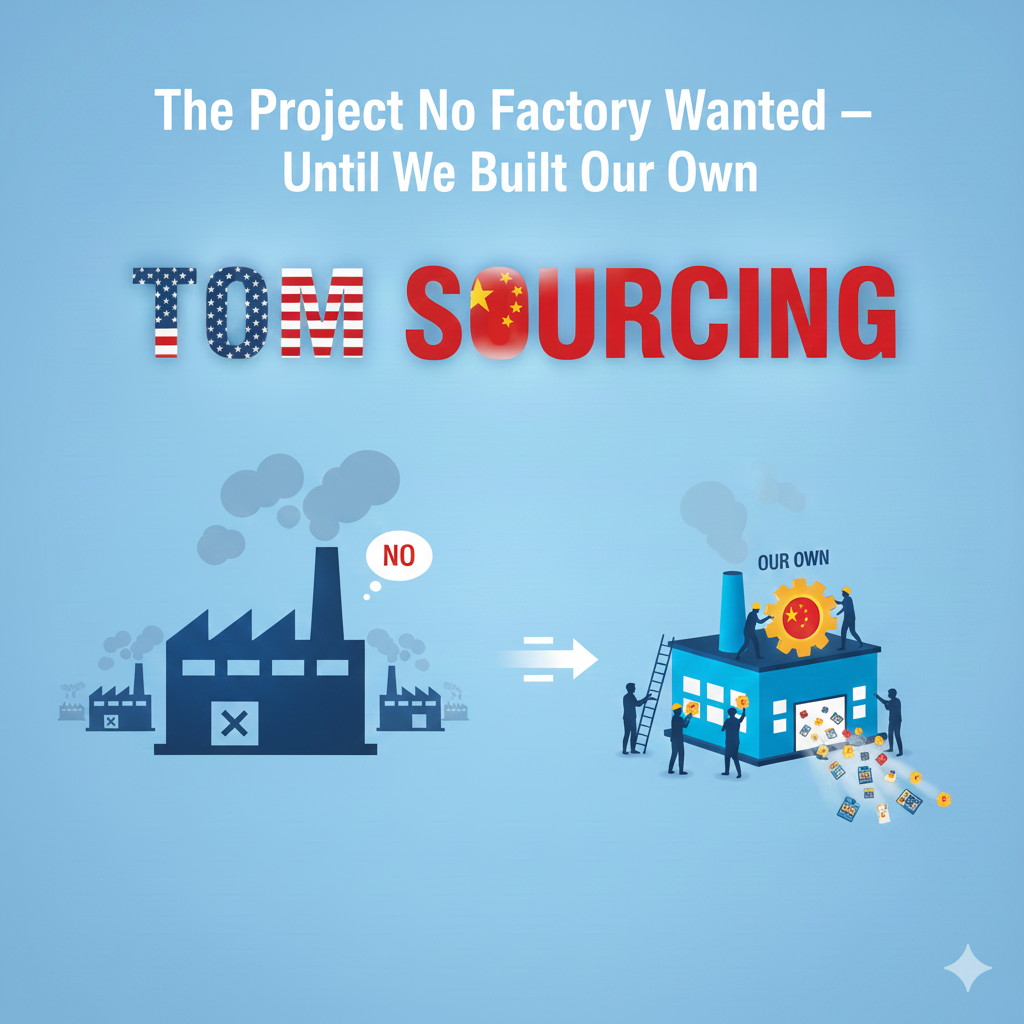
    The Project No Factory Wanted — Until We Built Our Own

    How Tom Sourcing Turned an “Impossible” Sewing Machine Project Into a Market Success

    When people talk about sourcing from China, they picture smooth communication, stable production, and suppliers lining up for orders. Reality is messier. Some projects—especially those involving multiple materials, tight tolerances, and no existing production line—are “factory nightmares” that no manufacturer wants to touch.

    This is the story of one such project.
    A sewing machine nobody wanted to produce.
    A project rejected again and again across Jiangsu, Zhejiang, and Guangdong.
    A project my former U.S. employer thought was “dead.”

    But it became one of my earliest victories—and later, a defining case study for Tom Sourcing.


    1. The Request That Looked Simple—But Wasn’t

    The U.S. company we worked for back then wanted to launch a custom-designed sewing machine for DIY creators: lightweight, safer for beginners, and with a unique stitch function.

    Simple on paper.
    A nightmare in reality.

    Most factories immediately asked:

    • “What’s your annual quantity?”
    • “How many models?”
    • “Who will pay for the new tooling?”

    When they heard the real numbers—initial 500 units, custom electronics, custom plastic housings, custom metal parts—they politely responded:

    “Not suitable for us.”

    Factories prefer predictable, stable, mass-volume projects.
    This sewing machine required:

    • Plastic injection molds
    • Metal stamping
    • Motors
    • PCBA
    • Tooling investment without guaranteed volume
    • Specialized assembly line setup

    For them, too much risk. Too little return.

    But as sourcing manager, it was my job to find a path—if not through a factory, then around the entire system.


    2. Mapping Out a Supply Chain That Didn’t Exist Yet

    Since no single factory wanted the whole project, I developed a multi-supplier plan:

    • Electronics + PCBA: Shenzhen
    • Motor + mechanical assembly: Changzhou
    • Plastic housing: Ningbo
    • Metal internal parts: Suzhou
    • Packaging: Shanghai
    • Final assembly: TBD—because no one would do it

    Instead of asking one factory to take everything, I broke it down piece by piece.
    This reduced risk for suppliers and increased our flexibility.

    But one problem remained: final assembly.

    No factory wanted to build a custom sewing machine from scratch.
    They didn’t have a line, and they didn’t want to change their workflow.

    So we made a bold decision.


    3. Building Our Own Small Assembly Line

    We rented a small workshop space.
    We brought in workers.
    We wrote our own SOPs for:

    • Assembly
    • Testing
    • Needle safety alignment
    • Motor torque calibration
    • Threading inspection
    • Drop test for packaging durability

    I coordinated everything:

    • Designed the workflow
    • Hired temporary labor
    • Managed quality checks
    • Tracked incoming materials
    • Built the first 100 units by hand—with the team

    It wasn’t glamorous.
    But it worked.

    And suddenly, something interesting happened.


    4. When You Build It, the Factories Come to You

    Once suppliers saw:

    • Real samples
    • Real testing equipment
    • A real workflow
    • A real purchase order

    Attitudes changed.

    Factories that said “不行” (not possible) a month earlier now said:

    • “Maybe we can take over assembly.”
    • “We can open a small line for you.”
    • “Let’s discuss long-term cooperation.”

    Why?

    Because in China manufacturing:

    Factories don’t like ideas.
    Factories like evidence.

    Once we created a feasible product—even by ourselves—the risk for suppliers dropped.
    They could see the structure.
    They could calculate costs.
    They could forecast volume.

    By the second production run, we already had two factories bidding to take over our assembly line.


    5. The Turning Point: Scaling the Production

    We ran full inspections on the first 500 units:

    • Load testing
    • Motor burn-in testing
    • Needle safety checks
    • Double QC for PCB stability
    • Packaging carton drop tests
    • Final functionality tests across all stitch modes

    Return rate after launch?
    Under 2%.

    For a brand-new electromechanical product, that was a huge win.

    And because we now had a proven product and stable demand, suppliers became motivated:

    • Tooling upgrades
    • Better packaging
    • Faster lead times
    • Lower MOQ
    • Lower labor cost
    • Higher consistency

    The project went from “nobody wants it” to “everyone wants it.”


    6. What This Project Means for Tom Sourcing Today

    This early experience shaped the DNA of Tom Sourcing.

    Today, we operate with:

    • A real office
    • Our own warehouse
    • The ability to hire temporary workers for assembly, labeling, repacking, and QC
    • 5 years of operating history
    • Import-export license
    • Full product development-to-shipment capability

    And most importantly:

    We don’t rely on suppliers to “believe” in a project.
    We make the project believable through engineering, samples, and execution.

    Sometimes a supplier says, “This project is too small.”
    Sometimes they say, “Too difficult.”
    Sometimes they say, “No existing line.”

    But if we believe the customer has a real market opportunity—

    we build the line, the system, or the sample ourselves.
    Just like the sewing machine project.

    That’s the TOM SOURCING difference.


    7. The Final Result

    Within 12 months, the project:

    • Secured two competing suppliers
    • Reduced unit cost by 18%
    • Improved QC consistency
    • Expanded into two new color variants
    • Hit a reorder cycle every quarter

    A project “no factory wanted” became one of the brand’s flagship products—sold in the U.S. and Europe.

    And yes—this case is absolutely suitable to be presented as a Tom Sourcing success story.

    Because the skills, mindset, and execution that made it possible
    are the same engines powering our company today.