Tag: supply chain management

  • The Most Expensive Decision You’ll Make Is Trying to Save $300 on Inspection

    The Most Expensive Decision You’ll Make Is Trying to Save $300 on Inspection

    There’s a moment every importer knows.

    You’ve found a supplier online. The website looks professional. The samples were decent. The price is right. You’re ready to place the order.

    But something feels off. You don’t really know this factory. You’ve never been there. Everything you know about them fits on a single webpage.

    So you consider hiring a third-party inspection agency. Then you see the quote — $300, $400, maybe more. And your order is only a few thousand dollars. Suddenly that inspection fee feels like a lot.

    So you cancel it. You tell yourself it’ll be fine. You’ve done your research. The supplier seemed honest. What could go wrong?

    A lot, as it turns out.


    The Psychology of “It’ll Probably Be Fine”

    Here’s the problem: the moment you decide to skip inspection, you’ve already set something in motion.

    Because your supplier thinks the same way you do.

    You want to save money. So do they. And if no one is coming to check, why would they spend extra on quality control? Why add an inspector on the production line — another salary, another cost — when the customer didn’t even bother to send someone?

    The decision you made in your budget spreadsheet quietly became a signal to your factory: we’re not being watched.

    And factories, like anyone else, respond to incentives.


    How a Simple MOQ Becomes a Two-Month Delay

    Here’s a real scenario that plays out more often than most buyers realize.

    A product has several components — let’s say a housing shell, electronic components, and packaging. Each has its own minimum order quantity set by the sub-supplier.

    The housing shell has an MOQ of 500 units. Why? Because making it requires setting up and adjusting a mold. That process takes half a day of skilled labor — expensive labor. For 50 units, the unit cost would be astronomical. For 500, it becomes viable.

    So the factory waits. Order A comes in for 100 units. Order B for 50. Order C for 150. They wait until they can combine enough orders to hit 500 before they even begin.

    Meanwhile, you’re waiting. And the factory isn’t lying, exactly. They’re just not telling you the whole story.

    The delivery date slips. Then slips again. Each time, there’s a new reason — a supplier delay, a production issue, a logistics problem. Each explanation sounds plausible. And you want to believe them, because the alternative — that you made a mistake — is uncomfortable.

    This is how months disappear.


    The Quality Control Question Every Factory Owner Faces

    Here’s the question that sits in front of every factory owner when your order hits the production line:

    Do I add a quality inspector, or not?

    It sounds like a simple operational decision. But it’s actually a financial one. An inspector is a cost. If margins are already tight, and the customer hasn’t sent anyone to check, the temptation to skip it is real.

    This isn’t malice. It’s economics.

    And here’s the uncomfortable truth: if you skipped your third-party inspection to save money, your factory is likely doing the same calculation on their end. Two parties, both cutting corners, both hoping the other one won’t notice.


    Your Supply Chain Is Not the Factory’s Job to Maintain

    This is the most important shift in thinking a brand owner can make.

    The factory is one piece of your supply chain. They are responsible for manufacturing. They are not responsible for your quality standards, your delivery commitments to your end customers, or your brand reputation. Those are yours.

    The moment you remove oversight — the person on the ground, the inspector at the line, the agent watching the container get loaded — you’ve handed the keys to someone whose incentives don’t perfectly align with yours.

    That’s not a criticism of factories. It’s just reality.

    What seems like a cost saving today is actually the first domino. Skip the inspection, and the factory skips their QC. Skip the QC, and a defect makes it into the carton. Skip the loading supervision, and the goods arrive damaged. Each “small” saving compounds into something much larger and much harder to fix.


    What the Right Investment Actually Looks Like

    Professional sourcing and inspection isn’t about distrust. It’s about accountability — for both sides.

    When a factory knows someone is coming, standards rise. Not because factories are dishonest, but because accountability drives performance. It’s the same reason companies have audits, restaurants have health inspectors, and construction sites have safety officers.

    The cost of proper oversight — sourcing agent fees, third-party inspection, loading supervision — is real. But it belongs in your budget the same way freight and duties do. It’s not optional. It’s the cost of doing business properly.

    The brands that treat it as optional eventually learn the same lesson, usually at a much higher price.


    The Bottom Line

    If you’re sourcing from China and wondering whether the inspection fee is worth it — it is.

    Not because something will definitely go wrong. But because the presence of oversight changes the behavior of every party in the chain, including the ones you’ll never meet.

    The $300 you save on inspection can easily cost you $3,000 in defective goods, re-production, delayed launches, and lost customers.

    We’ve seen it enough times to stop being surprised by it.

    If you want to talk about how to build proper oversight into your sourcing process without breaking the budget, get in touch with us.


    Tom Sourcing is a US-registered sourcing company with its own office and warehouse in China. We provide end-to-end sourcing, product development, quality control, and supply chain management for US and EU brands.
  • Why Buying the Cheapest Product Often Costs More in the Long Run

    Is Price Really Everything?

    When sourcing products, many buyers are tempted by the cheapest option. Take bearings, for example. A high-quality imported bearing can cost several times more than a domestically produced one. At first glance, the price difference seems prohibitive. So why do buyers still choose the imported version?

    The answer lies in total cost of ownership, not just the purchase price.


    The Hidden Costs of Cheap Products

    1. Shorter lifespan:
      A domestic bearing may only last half as long as an imported one. Replacing it more frequently increases downtime and labor costs.
    2. Higher operational risk:
      Cheap components are more prone to wear and tear, which can cause machinery failures and disrupt production schedules.
    3. Labor and replacement costs:
      Every time a bearing fails, technicians must stop production, replace it, and test machinery again. This often adds significant indirect costs, far exceeding the initial savings.
    4. Impact on business continuity:
      Unreliable products can affect client satisfaction, production efficiency, and long-term profitability. Sometimes, the money “saved” by buying cheap ends up costing more than a higher-quality, reliable product.

    Lessons Learned

    • Price is not the only factor: Quality, durability, and reliability are often more important than the lowest upfront cost.
    • Look at total cost, not unit cost: Consider labor, downtime, replacement, and risk.
    • Professional sourcing matters: An experienced agent can help identify suppliers that balance price and quality while avoiding hidden pitfalls.

    Conclusion

    In sourcing, a slightly higher price often leads to lower long-term costs. For businesses, choosing the right product is a balance between price, reliability, and operational efficiency. Remember: sometimes paying more upfront is the cheapest way to run your business smoothly.

  • The Hidden Cost of Low-Ball Suppliers

    What is a Low-Ball Supplier?

    In sourcing, a “low-ball supplier” refers to a factory or vendor that offers prices significantly below the market average. At first glance, it might seem like a bargain — but as the saying goes, “If it sounds too good to be true, it probably is.”


    The Process and Experience

    Working with low-ball suppliers often leads to a series of challenges:

    • Initial low quote → production issues: Even if the quote is attractive, production often suffers from repeated mistakes, misinterpretation of specifications, and overlooked requirements.
    • Repeated additional charges: Suppliers frequently ask for extra payments for items already in the contract.
    • Communication headaches: Each issue requires back-and-forth emails, calls, and clarifications, consuming valuable time.
    • Final result: Lost deposits, wasted time, frustration, and depleted energy — often more costly than working with a reliable supplier from the start.

    Analysis: Why Low Price Doesn’t Equal Savings

    • Low cost rarely accounts for quality, reliability, and risk management.
    • Hidden costs include time, oversight, management, and potential business disruption.
    • The cheapest option upfront often ends up being the most expensive overall.

    Conclusion / Lessons Learned

    • Choosing a supplier should prioritize reliability, execution capability, and communication, not just price.
    • A professional sourcing agent can filter out low-quality or inefficient suppliers, ensuring smoother production, fewer surprises, and better overall cost-effectiveness.

  • China Sourcing 101: The Complete Beginner’s Guide for Overseas Buyers

    If you’re new to China sourcing, this guide will save you months of frustration, thousands of dollars in mistakes, and countless hours wasted on the wrong suppliers.

    China is still the most complete, efficient, and adaptable manufacturing ecosystem in the world — but only if you know how to navigate it.
    This article will walk you through the fundamentals: how China’s supply chain works, how to start sourcing, how to choose suppliers, how to negotiate, how to set expectations, common misunderstandings, and the real role of a sourcing agent.

    Let’s dive in.


    1. Understanding the Chinese Supply Chain

    Before you talk to any supplier, you must first understand the ecosystem you are entering.

    China is not “one big factory”

    China’s manufacturing isn’t a single industry — it’s a hyper-dense network of:

    • Large factories
    • Mid-size specialized manufacturers
    • Small workshops
    • Trading companies
    • Family-run niche producers
    • Clusters of factories focused on one product (Yiwu, Shenzhen, Dongguan, Ningbo, Wenzhou, etc.)

    This density is why China can produce everything from hair clips to drones.

    Factories vs. Trading Companies vs. Workshops

    TypeStrengthsWeaknessesBest for
    FactoriesLower cost, strong productionHigher MOQ, less flexibleMature products
    Trading CompaniesFlexible, small MOQ, better communicationHigher pricingStartups, custom mixes
    WorkshopsUltra-low cost, fastQuality unstableLow-end items

    Misconception:
    “Factories are always better.”
    Not true.
    Many new buyers insist on “real factory only” — and lose good suppliers because of this obsession.

    Your goal is not to find a factory.
    Your goal is to find someone who can deliver your required quality, timeline, and service at a fair price.

    OEM, ODM, OBM (Know These or You’ll Suffer)

    • OEM → you give design, they produce
    • ODM → they design, you modify
    • OBM → they sell under their own brand

    Most Chinese suppliers are OEM/ODM — not brand owners.


    2. How to Start Sourcing

    Step 1: Know exactly what you want

    Most failed sourcing projects start with:

    “I want something like this — can you recommend?”

    In China sourcing, vague = expensive + slow + disappointing.

    Create a clear product brief:

    • Dimensions
    • Material
    • Color
    • Function
    • Packaging
    • Accessories
    • Target price
    • Target market
    • Safety standards (if any)

    Even a simple one-page brief makes suppliers take you seriously.

    Step 2: Do basic market research

    These platforms help you understand the baseline:

    • Alibaba (global suppliers, easy communication)
    • 1688 (China domestic platform; cheap but tricky for foreigners)
    • Temu / TikTok Shop (market trend reference)
    • Canton Fair / Global Sources (if you attend trade shows)

    You don’t need to become an expert — just understand the normal price range.

    Step 3: Decide whether you need a sourcing agent

    You need an agent when:

    • You’re customizing a product
    • You need multiple suppliers
    • You need packaging + inserts + assembly
    • You need QC
    • You need someone to check factories
    • You can’t visit China
    • You want long-term stable supply

    If your budget is tiny and you only want generic products, you may not need an agent.


    3. How to Choose Suppliers

    Rule #1: You are not picking the cheapest supplier

    You are picking the most reliable supplier.

    Factory vs. trading company — the truth

    Factories can be cheaper, but:

    • Their MOQ is high
    • They hate small orders
    • They can’t do “mix and match”
    • They are not always good at communication
    • Customization may be slow
    • They prefer stable long-term clients

    Trading companies often provide:

    • Small MOQ
    • Faster replies
    • Better English
    • Better flexibility (combine products, pack sets, add inserts)

    In real life, many successful brands quietly work with trading companies.

    Checklist to judge a supplier

    Look for:

    • Matching product line
    • Reasonable pricing
    • Fast, clear communication
    • Transparent answers (not vague)
    • Willingness to send samples
    • Factory certificates (if needed)
    • Stable production timeline
    • No emotional behavior (yes, this happens)

    If anything feels “off,” walk away.

    Samples are everything

    I’ll be direct:

    A supplier who refuses to send samples is not trustworthy.

    Sample quality is the most honest indicator of:

    • Tooling capability
    • Material consistency
    • Packaging skills
    • Quality control mindset

    Never skip samples.

    Verification

    Ways to verify a supplier:

    • Pay for a third-party factory audit
    • Request business license
    • Check registration year
    • Check if their catalog is consistent
    • Video call tour of factory
    • Ask for raw material sources
    • Total annual output / main markets

    4. How to Negotiate

    Chinese suppliers don’t like “price killers”

    If your opening message is:

    “Your price too high. Give me best price.”

    The supplier will instantly put you in the “low-priority customer” group.

    Negotiate with structure, not emotions

    What suppliers respond well to:

    • Clear requirements
    • Clear quantity
    • Clear timeline
    • A sense you know the market price
    • Potential repeat orders
    • Professional communication

    Golden rule: Offer value before asking for concessions

    Value you can offer:

    • Consistent orders
    • Long-term cooperation
    • Clear forecast
    • Faster payment terms
    • Flexible delivery windows

    Negotiation is relationship-building — not a price war.


    5. How to Set Expectations

    Sample ≠ mass production

    This is the most painful lesson for new buyers.

    Why?

    Because samples are handmade — mass production is not.

    Expect differences in:

    • Color
    • Texture
    • Stitching
    • Alignment
    • Minor size tolerances

    Good factories will try to match samples — but 100% identical is unrealistic.

    Understand production timeline

    A typical flow:

    1. Product brief
    2. Quote
    3. Samples
    4. Revision
    5. Final sample
    6. Purchase order
    7. Production (20–35 days)
    8. QC
    9. Packing & shipping

    If you need perfection, expect multiple rounds.

    Don’t change specs halfway

    Scope creep kills good projects.

    If you keep modifying after production starts, delays will follow — anywhere in the world.


    6. Common Misunderstandings

    1. “Factories always give better prices.”

    No — factories often quote higher than trading companies for small orders.

    2. “Chinese suppliers can do anything.”

    They can do many things, but not magic.

    3. “Why is sample great but mass production only OK?”

    Because samples are handcrafted; mass production has tolerances.

    4. “Suppliers don’t reply — they are rude.”

    More likely:
    Your quantity is too small, or your brief is unclear.

    5. “I want the factory directly to save money.”

    Sometimes this mindset leads buyers straight into scams or poor service.

    6. “Why can’t they do it as I imagine?”

    Because imagination is not an engineering drawing.


    7. What Sourcing Agents Actually Do

    A good sourcing agent is not “someone who finds factories.”
    A real agent manages the full stack:

    • Supplier research
    • Price verification
    • Sample management
    • Negotiation
    • Order follow-up
    • Production monitoring
    • Quality control
    • Pre-shipment inspection
    • Packaging solutions
    • Consolidation at warehouse
    • Export documentation
    • Customs
    • Shipping
    • Problem-solving (the most important)

    A good agent saves you time, money, and mistakes — and ensures stable supply.


    Conclusion

    China sourcing is not complicated — it’s structured.

    If you understand the supply chain, define your needs clearly, verify suppliers properly, set reasonable expectations, and work with the right partners, you can build a reliable and scalable supply chain in China.

    If you want a trusted partner to guide you through the process — we’re here.

    👉 Start Your Project Today

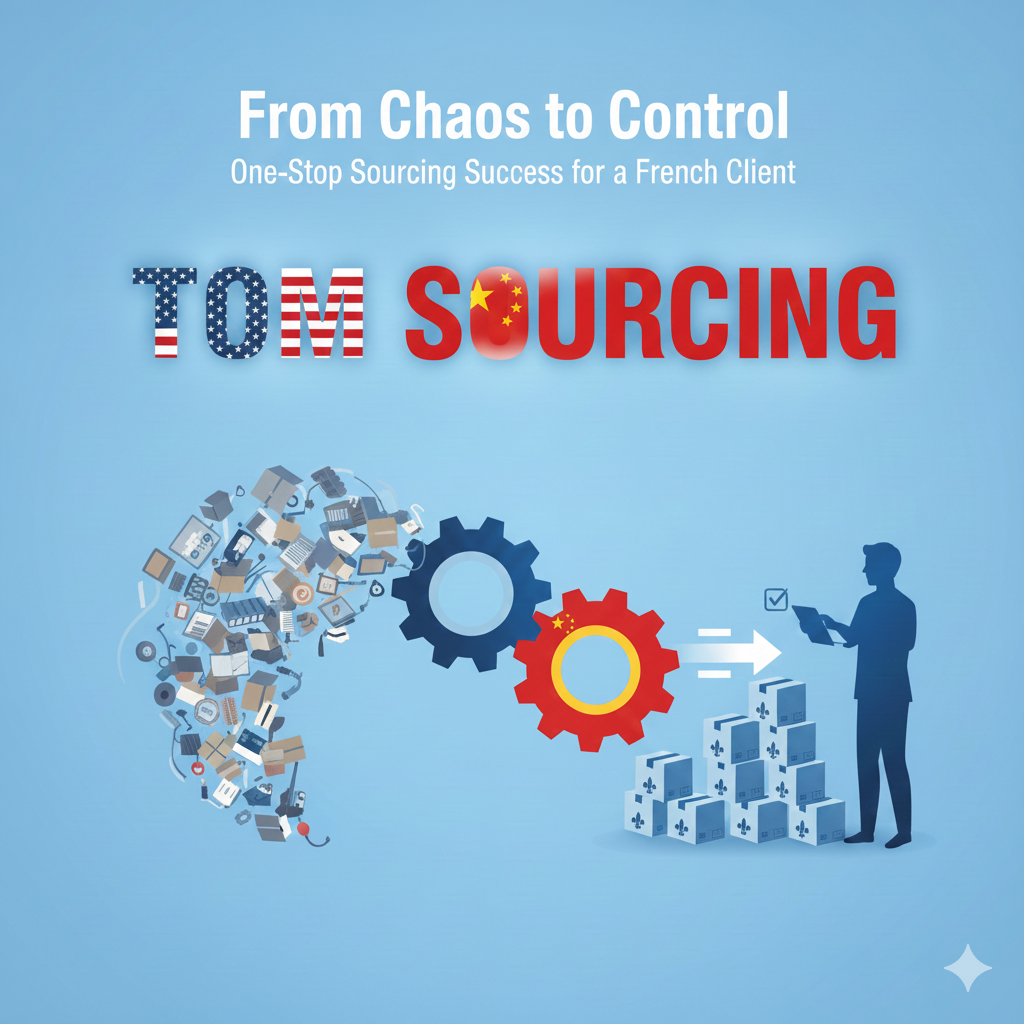
  • From Chaos to Control — One-Stop Sourcing Success for a French Client

    From Chaos to Control — One-Stop Sourcing Success for a French Client

    Client Background

    Industry: Collectibles & Model Kits Retail
    Country: France

    A French collectibles store wanted to import model kits and figures from multiple brands in China. However, each brand had small quantities, and managing so many suppliers and shipments was difficult for them. They needed a reliable partner to coordinate sourcing, inspection, and shipping.


    Challenges

    1. Numerous brands and SKUs, each with small quantities, made consolidation and logistics complex.
    2. Many forwarders refused to handle branded goods due to customs risks, even though all products were legitimate.
    3. Shipping required special export channels to comply with regulations.
    4. Shipments often arrived with damaged packaging or missing cartons.
    5. Some unreliable forwarders disappeared or went bankrupt, causing heavy losses to the client.

    What We Did

    1. Rented a dedicated warehouse space in China to manage this client’s inventory.
    2. Collected products from multiple brands and suppliers, then consolidated them in our warehouse.
    3. Inspected each delivery upon arrival, rejecting damaged cartons.
    4. Reinforced cartons with protective plastic corners to prevent damage during transit.
    5. Upgraded our business license to include import and export rights, allowing us to ship under our own company name and ensure compliance.
    6. Selected stable, trusted forwarders to guarantee safer, trackable transportation.

    Outcome

    ✅ Zero missing boxes since we took over the logistics.
    ✅ No more complaints about broken cartons.
    ✅ The client has continued working with us for over five years — relying on Tom Sourcing for end-to-end supply chain management.


    Key Takeaway

    This case shows how our one-stop sourcing service helps small and medium clients handle complex, fragmented supply chains — ensuring reliability, visibility, and peace of mind from order to delivery.


    Work With Us

    Want to simplify your China sourcing just like this?
    👉 Start Your Project