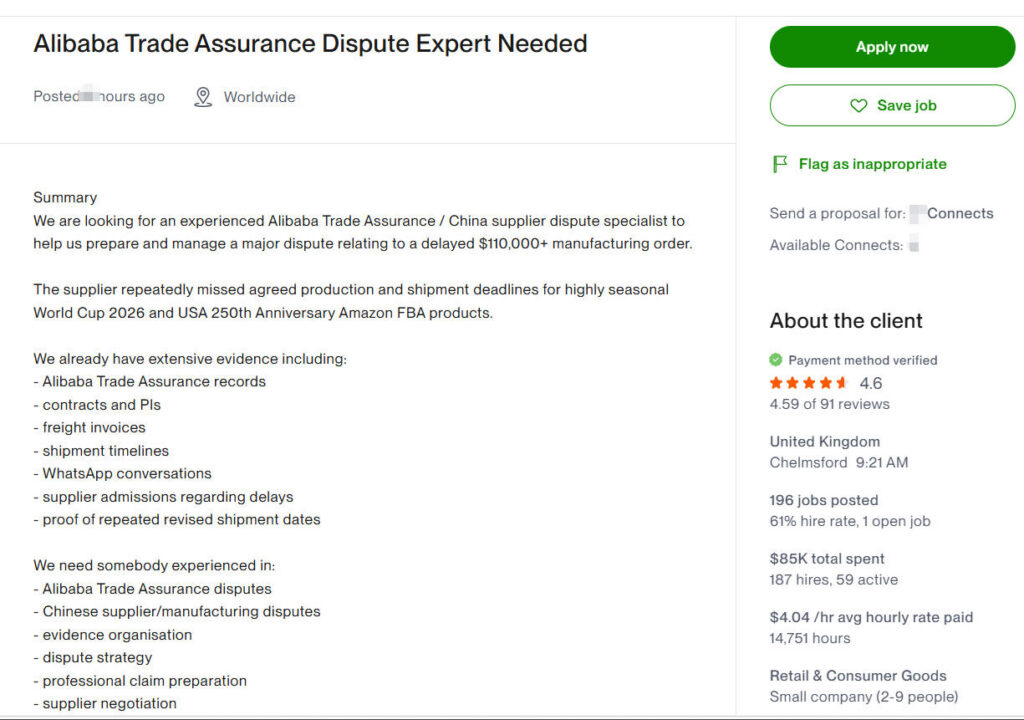
As a sourcing agent, we often encounter new or inexperienced B2B buyers with demands like:
“I want the best quality and lowest cost…”
“I want you to do A-Z for me.”
“No MOQ.”
At first glance, these requests seem reasonable to someone unfamiliar with international trade. But in reality, they are often impossible to satisfy without major compromises.
Why These Demands Are Unrealistic
No MOQ: Suppliers have minimum order quantities for a reason. Ignoring them can make production uneconomical or unfeasible.
A-Z service: Expecting a sourcing agent to manage everything from design to delivery without collaboration increases risk and workload.
Best quality + lowest cost: Trade-offs are inevitable. High quality requires proper materials, processes, and oversight — none of which are free.
Most experienced buyers understand these compromises and plan accordingly.
Lessons from Real Cases
In our experience, buyers who insist on unrealistic demands often:
Encounter delayed shipments, quality issues, or unexpected costs
Fall victim to scams or unreliable suppliers
End up frustrated and unable to meet their market goals
These cases highlight the importance of setting realistic expectations and leveraging professional sourcing expertise.
Conclusion
Successful procurement requires balanced expectations and professional collaboration. Understanding what is feasible, respecting supplier requirements, and using an experienced sourcing agent can prevent costly mistakes and protect your business.
When it comes to sourcing products from China, not all businesses operate the same way. Some small companies, especially one-person operations, try to handle sourcing themselves, browsing Alibaba or other online platforms. Mid-size companies, on the other hand, often outsource sourcing to professional agents.
The question is simple: Should you do it yourself, or hire a sourcing agent?
Case Comparison
Mid-Size Companies
Cost-effective: Using a sourcing agent often works out cheaper than hiring in-house staff.
Risk management: Suppliers are pre-vetted, and potential issues are caught early.
Quality control: Processes are managed professionally, ensuring product standards.
Small / Micro Companies
Higher hidden costs: Time spent researching suppliers, verifying factories, and troubleshooting problems.
Increased risk: More likely to encounter scams, low-quality suppliers, or missed deadlines.
Low success rate: One or two failed orders can seriously impact business survival.
Deeper Analysis
Professional sourcing provides time savings, risk reduction, and guaranteed quality. DIY sourcing may seem cheaper upfront, but the hidden costs of trial-and-error, communication barriers, and logistics challenges often outweigh the savings.
Key Takeaways
Scale matters: Procurement strategies should align with your company’s size and capacity.
Evaluate risk: Small companies need to weigh potential savings against operational and financial risks.
Leverage expertise: Sometimes, paying for professional sourcing saves far more in time, money, and stress than attempting DIY.
While sourcing products in China, it’s not uncommon to stumble upon your competitor’s supplier. At first glance, it might feel like a stroke of luck — maybe the factory you wanted to work with already has a proven track record, and the product seems accessible. But is it truly a good thing? The answer depends on your product strategy.
Case Analysis
1. Private Label / Standard Products
Pros: Prices are transparent, production is straightforward, and it’s easy to replicate the product quickly.
Cons: Profit margins are limited, and there is little room for brand differentiation. Every competitor has access to the same supplier and product, which can saturate the market.
2. Deep Customization / Proprietary Products
Cons: Factory confidentiality may be weak. Your designs, specifications, and technical requirements could be exposed to competitors.
Risks: Competitors could copy or preemptively manufacture similar products, undermining your uniqueness and competitive advantage.
Key Takeaways
Professional sourcing protects custom content: Experienced sourcing agents can screen suppliers, evaluate reliability, and ensure sensitive designs are secure.
Know the difference between private label and deep customization: Strategy matters. Not every “accessible” factory is appropriate for all product types.
Experience matters: A sourcing agent’s firsthand knowledge helps identify potential pitfalls that aren’t obvious from online listings.
Why This Matters to You
Sourcing isn’t just about finding a factory — it’s risk management for your product and brand. Choosing the right supplier can mean the difference between a successful launch and wasted resources. Protect your designs, protect your margins, and leverage professional sourcing expertise to navigate these challenges effectively.
Packaging is more than just a box—it’s your product’s first impression and a critical part of logistics and branding. In our five years operating a licensed sourcing company with an office and warehouse, we’ve helped clients from startups to SMEs source packaging efficiently, ensuring both cost-effectiveness and quality.
1. Packaging Types
When sourcing in China, the most common packaging options include:
Corrugated boxes: Cost-effective, customizable, good for shipping durability
Rigid gift boxes: Premium look for retail and gifts
Plastic trays and clamshells: Used for electronics and small parts
Flexible packaging: Pouches, bags, and films for consumables
Tip: Choose packaging based on product fragility, customer experience, and shipping method.
2. Cost Drivers
Several factors impact packaging costs:
Material type (cardboard, plastic, bamboo, paperboard)
Printing method (offset, digital, embossing)
Quantity and MOQ requirements
Special finishing (lamination, foil stamping, embossing)
Labor for assembly or custom inserts
Example: A European client ordered 1,000 units of rigid gift boxes. Lamination and foil stamping doubled the per-unit cost compared to plain boxes, but significantly increased brand perception and perceived value.
3. Minimum Order Quantity (MOQ)
Many Chinese suppliers set MOQs based on production efficiency:
Corrugated boxes: 500–1,000 units
Custom-printed pouches: 2,000–5,000 units
Premium rigid boxes: 1,000+ units
Practical Tip: Work with a sourcing agent to negotiate MOQs or consolidate orders from multiple SKUs to meet requirements without overstocking.
4. Design Tips
Effective packaging balances cost and branding:
Keep design simple yet impactful
Use mock-ups or prototypes before mass production
Ensure dielines and measurements are accurate for inserts
Consider printing colors vs. post-production stickers for cost efficiency
Case Example: A US client requested a 5-color print for a small batch of tote bags. We advised reducing to 3-color printing with spot varnish for branding, cutting costs by 25% while maintaining aesthetics.
5. Sustainability Trends
Global buyers increasingly prioritize sustainable packaging:
Recyclable cardboard and paperboard
Compostable or biodegradable plastics
Minimalist design to reduce material waste
Practical Tip: Sourcing agents can identify suppliers who meet both sustainability goals and quality standards, balancing cost and eco-conscious branding.
6. How Professional Sourcing Helps
Our licensed company, with office and warehouse support, provides:
Supplier vetting and comparison
Sample evaluation before mass order
MOQ negotiation
Quality and compliance checks
This ensures packaging not only protects products but also enhances brand perception and logistics efficiency.
Conclusion
Packaging sourcing in China requires balancing cost, quality, and branding. By understanding types, MOQs, and best practices, buyers can avoid surprises, reduce hidden costs, and maintain product integrity.
Engagement CTA: What’s your biggest packaging challenge? Comment below or contact us to discuss tailored solutions for your products.
When sourcing from China, the temptation of a low price can be strong. However, “cheap” often comes with hidden costs, quality risks, and delays that end up costing far more than paying a fair price upfront. In our five years operating a licensed sourcing company with an office and warehouse, we’ve seen first-hand how chasing the lowest price can backfire — and how professional sourcing mitigates these risks.
1. Low Price, Low Quality
Suppliers offering the lowest price often cut corners in materials, labor, or QC processes. While the unit cost looks attractive, you may face:
Poorly finished products
Inconsistent specifications
Higher defect rates
Example: A US electronics buyer ordered chargers at the cheapest rate and discovered 20% of units failed quality testing upon arrival — turning a $1,000 order into $3,000 in replacements and delays.
Practical Tip: Compare supplier quotes carefully. If a price seems unusually low, investigate the production process and quality control before committing.
2. Hidden Costs
“Cheap” pricing often excludes essential costs:
Mold fees
Packaging adjustments
Sample fees
Inspection fees
Example: A European client ordered plastic components at a bargain price. When reworks and inspection fees were added, the total cost surpassed mid-range competitors.
Professional sourcing agents help you account for these hidden costs, ensuring the final price reflects the true expense.
3. Defects and Reworks
Low-cost manufacturers may skip crucial steps:
Material testing
Functional testing
Standardized assembly
Impact:
Increased returns
Customer complaints
Additional labor to fix defective units
Case in Point: A promotional product supplier ordered 500 branded water bottles at the lowest quote. 100 arrived with leaking lids, causing shipment delays and reputational damage.
4. Delays and Missed Deadlines
Cheaper suppliers often juggle multiple orders without adequate resources. Cutting corners on labor or scheduling can lead to:
Late delivery
Partial shipments
Lost sales
Real Scenario: During a pre-Chinese New Year production, a startup sourced low-cost tote bags. The factory promised delivery in 15 days but took 35 days, jeopardizing a seasonal sales campaign.
5. Relationship Issues
Suppliers providing extremely low prices may:
Be difficult to communicate with
Lack flexibility for changes or customizations
Cut corners on contract commitments
Why It Matters: Strong supplier relationships are essential for long-term sourcing success. Working with a reliable partner, even at a slightly higher price, prevents unnecessary disputes and ensures consistent quality.
6. How Professional Sourcing Protects You
As a licensed company with our own office and warehouse, we provide:
Verified supplier selection
Quality inspections before shipment
Transparent cost analysis
Risk mitigation strategies
This ensures your “cheap” option doesn’t become an expensive lesson.
Conclusion
The allure of a low price can be dangerous in China manufacturing. True savings come from balancing cost with quality, reliability, and professional oversight. A fair price with a trusted supplier and sourcing partner saves time, money, and stress.
Engagement CTA: Have you been burned by a “cheap” supplier? Share your experience or contact us to discuss how to safeguard your orders while optimizing cost.
When sourcing from China, overseas buyers often wonder: should I deal with a factory or a trading company? The answer depends on product type, order size, complexity, and quality requirements. In our five years running a licensed sourcing company with an office and warehouse in China, we’ve worked with both types and seen how the choice impacts cost, lead time, and risk. Understanding the differences helps you make smarter sourcing decisions.
1. How to Tell Factories and Trading Companies Apart
Factories:
Manufacture products in-house
Have production lines and machinery
Can offer customizations and ODM/OEM services
Typically require larger MOQs
Trading Companies:
Act as intermediaries between buyers and factories
Source products from multiple factories
Often handle export documentation, shipping, and logistics
May offer smaller MOQ flexibility
Practical Tip: Check factory certifications, visit websites, and ask about production capabilities. If a supplier offers dozens of unrelated products at low MOQ, it’s likely a trading company.
2. When Trading Companies Are Better
Small orders: Trading companies can consolidate products from multiple factories to meet low MOQ requirements.
Simpler products: For generic items like office supplies or electronics accessories, trading companies save time.
Expedited shipping: Trading companies often handle logistics and customs efficiently, reducing lead time for multiple products.
Language & communication support: They usually have staff fluent in English, streamlining instructions.
Example: A US startup ordering 50 units each of 5 different stationery products may find a trading company more efficient than negotiating with 5 separate factories.
3. When Factories Are Better
Customization required: Factories can produce your exact design and approve samples.
High volume orders: Factories can scale efficiently without markups.
Better cost control: Direct factory pricing is usually lower than trading companies, especially for large orders.
IP protection: You reduce the risk of product or design exposure when working directly with a trusted factory.
Example: A European consumer electronics brand ordering 5,000 custom-designed chargers benefits from factory direct sourcing for quality and cost efficiency.
4. What Sourcing Agents Do Differently
Working with a professional sourcing agent (like us) combines the benefits of both:
Factory verification: We inspect capabilities, production lines, and certifications.
Trading company vetting: We assess reliability and consolidation capacity.
Order management: We coordinate communication, sample approvals, and QC on your behalf.
Risk reduction: We minimize delays, defects, and miscommunication with on-the-ground monitoring.
Practical Tip: Choosing an agent with an office, warehouse, and 5+ years of sourcing experience ensures that whether your supplier is a trading company or factory, your order stays on track.
5. Summary Table
Type
Best For
Pros
Cons
Factory
Large, customized orders
Lower cost per unit, full control, customization
Higher MOQ, longer lead time, communication may be slower
Trading Company
Small or mixed orders
Low MOQ, faster consolidated shipping, easy communication
Slightly higher cost, less control, potential IP exposure
Conclusion
Understanding whether to use a factory or a trading company can save you money, time, and headaches. There’s no universal answer; it depends on your product, quantity, and customization needs. Leveraging an experienced sourcing partner with a licensed office, warehouse, and years of experience ensures that your orders are handled efficiently and professionally, regardless of supplier type.
Engagement CTA: Have you had challenges working with trading companies or factories in China? Share your experience in the comments or contact us to discuss how to choose the right partner for your project.
Most overseas buyers underestimate how long manufacturing in China really takes. Lead times on Alibaba or supplier websites rarely reflect reality. In our five years running a licensed sourcing company with an office and warehouse in China, we’ve seen firsthand how delays, miscommunications, and overlooked processes add days or even weeks to production. Knowing the real timeline is crucial to plan inventory, cash flow, and market launches.
1. Design Phase
What happens: The first step is turning an idea into a manufacturable product. Buyers often submit sketches or references without detailed specs. Factories need precise dimensions, materials, colors, and functions before anything else can start.
Why it matters: Incomplete designs lead to back-and-forth revisions, adding days or weeks. In China, factories won’t produce until all drawings and materials are confirmed.
Practical tip: Create a simple spec sheet with materials, dimensions, and usage notes. Even a rough prototype helps suppliers estimate feasibility accurately.
2. Prototype
What happens: Once design specs are ready, factories produce a prototype to test materials, dimensions, and function. For electronics or apparel, this may include testing components, fabrics, or trims.
Key challenges:
Material substitution may happen if the original isn’t available.
Prototype costs are often underquoted.
Communication is critical to ensure the prototype matches your expectations.
Practical tip: Always approve the prototype in writing (photos or videos) and note any changes for the final product.
3. Engineering Sample (Pre-Mass Production Sample)
What happens: After the prototype, a final engineering sample is made using production-grade tools and molds. This sample reflects the quality, weight, and function of mass production units.
Why it matters: Skipping or rushing this step can result in major quality issues during bulk production. It is also the last chance to identify hidden defects.
Practical tip: Inspect thoroughly: dimensions, tolerances, color consistency, material feel, and functionality.
4. Mold Making / Tooling
What happens: For injection-molded plastics, metal stamping, or custom parts, factories need to create tooling or molds. Lead times vary: simple molds may take 1–2 weeks, complex molds 4–6 weeks.
Common pitfalls:
Buyers assume “once the prototype is approved, mass production is ready.”
Any design change after mold creation can add weeks and extra costs.
Practical tip: Confirm final design before ordering molds. Budget for potential mold adjustments.
5. Mass Production Run
What happens: With molds ready and samples approved, factories schedule production. Factors affecting timeline:
Current factory workload
Material availability
Production line efficiency
QC processes
Reality check: Delays are common. Overseas buyers often expect “X units in 2 weeks” but overlook internal bottlenecks, Chinese holidays, or material shortages.
Practical tip: Plan buffer time. Work with a sourcing agent (like us) who monitors production on the ground and flags delays early.
6. Quality Control During Production
What happens: Inspections can be done mid-production or pre-shipment. QC focuses on dimensions, function, assembly, and packaging. Without QC, buyers risk receiving defective goods.
Practical tip: Arrange for at least one mid-production check and a pre-shipment inspection. Document results with photos/videos.
7. Packaging and Labeling
What happens: Packaging may be customized: branded boxes, inserts, and barcodes. Factories often underestimate packaging time. Miscommunication can lead to missing labels, wrong carton sizes, or poorly packed products.
Practical tip: Provide exact packaging instructions, carton sizes, and labeling requirements. Verify all details in writing.
8. Shipment Preparation
What happens: After QC and packaging, goods are moved to warehouse or forwarder for export. Customs documentation, shipping method, and freight preparation can add several days.
Practical tip: Plan for 1–2 days for export preparation per shipment. Air freight is faster but more expensive; sea freight is cheaper but slower.
9. Shipping & Delivery
What happens: Goods leave China via sea, air, or rail. Lead times are influenced by carrier schedules, customs clearance, and seasonal congestion.
Practical tip: Track shipments closely. Delays often occur at port or customs, not the factory.
10. Post-Delivery
Even after goods arrive, there can be minor issues: broken cartons, missing items, or damaged products. Having a sourcing partner on the ground ensures quick resolution.
Practical tip: Keep photos, check cartons immediately, and report any issues to suppliers promptly.
Summary Table: Realistic Timeline (Example for 1000 Units)
Stage
Typical Duration
Design
3–7 days
Prototype
5–10 days
Engineering Sample
7–14 days
Mold / Tooling
14–40 days
Mass Production
10–30 days
QC & Packaging
3–7 days
Shipment Prep
2–4 days
Freight
5–30 days (depending on method)
Note: Variations depend on product complexity, factory workload, and Chinese holidays.
Conclusion
Understanding the full manufacturing timeline in China is not optional — it’s critical. Relying solely on Alibaba lead times or supplier promises is risky. Working with a licensed sourcing company with an office, warehouse, and 5 years of experience ensures:
Accurate timeline monitoring
QC oversight
Smooth shipping coordination
Quick issue resolution
If you want your project delivered on time and within budget, don’t skip any step.
Engagement CTA: Have you faced delays or surprises in Chinese manufacturing? Comment below or contact us — let’s discuss how to avoid costly mistakes.
Most overseas buyers assume RFQs are simple: send product details, wait for quotes, compare prices, and pick a supplier. In reality? Over 70% of RFQs fail — ignored, misunderstood, or replied with sky-high prices.
If you’ve sent RFQs on Alibaba, Made-in-China, or through email and barely receive serious responses, it’s not because China suppliers “don’t care.” It’s because the RFQ itself is incomplete, confusing, or simply not attractive for a factory to invest time in.
After five years running a sourcing company with our own office, warehouse, and import/export license in China, we’ve seen thousands of RFQs — the good ones, the bad ones, and the ones that collapse instantly. This guide explains why RFQs fail and how to fix them so suppliers actually respond, quote accurately, and take you seriously.
1. Why Suppliers Ignore RFQs
Factories ignore RFQs for very predictable reasons — and none of them are personal.
1. The RFQ Lacks Key Information
Suppliers can’t quote if you don’t tell them:
materials
dimensions
target quantity
packaging requirements
standards or certifications
Missing info = no quote.
2. The RFQ Looks Like a “Price-Shopping” Bulk Send
If your message looks like it was copy-pasted to 50 suppliers… Suppliers assume:
you won’t buy
you only want the cheapest price
you will disappear after the quote
Factories prioritize serious buyers.
3. Your Target Quantity Is Too Small for the Factory
A mold that costs $3,500 for a 500-unit order is not attractive for a medium-sized factory.
4. The Factory Doesn’t Make Your Kind of Product
You’d be surprised: Over 30% of RFQs are sent to the wrong type of supplier.
Some trading companies will still respond (with inflated prices). Factories simply ignore.
5. Your RFQ Raises Red Flags
Examples:
unclear target market
unclear certification needs
unrealistic expectations
timeline too rushed
you ask 30 questions upfront
Suppliers avoid risk.
2. How to Write a Good RFQ
A strong RFQ does three things:
Shows you are serious.
Gives suppliers confidence the project is feasible.
Makes quoting easy and clear.
Here’s how to write one.
1. Start with a Brief, Professional Introduction
Show credibility — not too much, not too little.
Example: “We are a small trading company with five years of experience and our own office and warehouse in China.”
This line tells suppliers: You are real. You have stability. You have experience.
2. Describe the Product Clearly
Include:
materials
dimensions
weight
color
functions
components or accessories
packaging
Clear RFQ = faster, more accurate quotation.
3. Provide Target Quantity (Even if Estimated)
Factories need to know:
if your project is worth their time
how to allocate production capacity
whether they should offer tiered pricing
Never say: “Quote me your best price.” Say: “Please quote for 500 units and 1,000 units.”
4. Add Reference Photos or Sketches
A simple picture eliminates 80% of misunderstandings.
5. Include Special Requirements Early
Such as:
certification (CE, FCC, FDA)
custom mold
custom printing
custom packaging
special materials
Surprising a factory later = delays + extra cost.
3. What Information Suppliers Actually Need
Most buyers think RFQs are one-way communication. But a factory needs very specific data to quote correctly.
Here’s what they require:
1. Technical Requirements
materials
thickness
tolerance
finish
colors
weight
2. Quality Requirements
drop test level
waterproof level
cosmetic standard (AQL)
function test requirements
3. Packaging Requirements
box type
carton size
labeling
shipping marks
4. Usage Environment
Some materials cannot survive:
high temperature
UV exposure
chemical exposure
heavy outdoor use
5. Target Market
Certifications vary by country: EU ≠ USA ≠ Australia.
6. Budget Range
Factories need to know whether your expectations are realistic.
Providing this information dramatically increases the chance of getting serious quotations — and reduces misunderstandings that can cost you thousands later. At our warehouse, we often verify samples and packaging specifications in person before confirming with factories, helping clients avoid preventable mistakes.
4. How to Avoid Misunderstandings
This is where most RFQs fail — not at the quoting stage, but during communication.
Here’s how to fix it.
1. Be Extremely Clear with Numbers
Chinese factories prefer clarity:
“10 cm ± 0.5 cm”
“Polybag with barcode”
“Logo: Pantone 1787C”
Avoid words like “about,” “roughly,” or “similar to.”
2. Never Assume the Factory Understands Your Market
Factories don’t automatically know:
your country’s regulations
your customers’ expectations
your marketing promise
Spell everything out.
3. Use Bullet Points, Not Long Paragraphs
Factories read fast. Bullets = less misinterpretation.
4. Confirm Everything in Writing
If you discussed on call, always send a recap:
specs
materials
packaging
deadlines
payment terms
5. Use Sample Approval as the Final Standard
This is why our company keeps approved samples in our warehouse: Factories must match the approved version, not their interpretation.
Conclusion: A Good RFQ Saves Time, Money, and Your Entire Project
RFQs don’t fail because suppliers are unreliable. They fail because the RFQ is unclear, unattractive, or incomplete.
A clear RFQ:
gets more responses
gets accurate pricing
avoids misunderstandings
makes factories take you seriously
And if you’re unsure how to structure a strong RFQ, a professional sourcing partner with an office, warehouse, and full import/export license in China can remove the guesswork and manage the RFQ process properly.
Have you had an RFQ ignored or misunderstood before? Share your experience below — or message us if you want help creating RFQs that get real results.
China is the world’s electronics powerhouse. From PCB fabrication to full product assembly, the country’s manufacturing ecosystem offers unmatched speed, flexibility, and cost efficiency. But sourcing electronics is very different from buying bags, toys, or home goods. Electronics carry higher risks, require tighter quality standards, and demand serious supplier vetting.
With over five years of operating a professional sourcing company in China—with our own office, warehouse, and full import/export licenses—we’ve handled electronics projects from prototype to mass production. This guide breaks down everything overseas buyers must understand before entering the electronics supply chain.
Let’s dive into the core elements: PCB suppliers, component sourcing, QC standards, certifications, lead times, and the hidden risks most beginners overlook.
1. PCB Suppliers: Your Product’s Foundation
Every electronic product starts with a PCB (printed circuit board). A great PCB ensures stability and durability; a bad one causes overheating, failure, and customer complaints.
Types of PCB Manufacturers
China has three main categories:
1. Tier-1 PCB Factories (Shenzhen, Huizhou)
Extremely stable quality
Ideal for medical, automotive, industrial electronics
Higher MOQs
Higher prices
These factories follow strict international standards and are suitable for serious brands.
2. Mid-Tier PCB Factories (Dongguan, Zhongshan)
Best balance of cost + quality
Flexible MOQs
Suitable for consumer electronics
These are the most common for commercial products.
3. Low-End PCB Workshops
Cheap but inconsistent
No process control
Very risky for mass production
Workshops occasionally appear reliable for samples but fail during bulk runs.
Pro tip: Always verify:
Layer count capability
Copper thickness
Tolerance consistency
Whether they outsource any stage (many do)
Our team often conducts on-site audits or stores incoming PCB shipments temporarily in our warehouse to perform independent checks before assembly.
2. Component Sourcing: The Most Dangerous Step
Electronics rely heavily on components—chips, capacitors, ICs, connectors, sensors. This step carries the highest risk because counterfeit components are widespread in China.
Sources of Components
Official Distributor Channels (e.g., DigiKey CN, Mouser CN)
Most reliable
More expensive
Longer lead time
Authorized Chinese Distributors
Still reliable
Better prices
Shenzhen Huaqiangbei Open Market
Extremely fast
Cheap
Highest risk (counterfeits extremely common)
Typical Problems
Fake branded chips
Recycled components sold as new
Components with altered manufacturing dates
Old stock that fails QC
Whenever we handle electronics projects, we always implement:
Component batch tracking
Warehouse-level inspection before assembly
Random sample testing
This dramatically reduces risks for overseas clients who cannot physically check components.
3. QC Standards: You Cannot Compromise Here
Electronics require strict, layered QC systems.
Three Levels of QC You Must Enforce
1. Incoming Component Inspection
Check:
Solderability
Date codes
Moisture exposure
Packaging integrity
2. In-Process Quality Control
Includes:
SMT inspection
Functional testing
Burn-in testing for heat-sensitive devices
3. Final QC
Typically includes:
Aging test
Drop test
Power-on test
Firmware stability testing
Many factories skip 2 of these 3 stages unless required.
Tip: Always create a written QC standard. Our company routinely stores finished batches in our warehouse and performs extra tests before shipping to reduce DOA (dead on arrival) complaints.
4. Certifications: Mandatory, Not Optional
Different markets require different certifications:
United States
FCC
UL (optional but recommended)
Europe
CE
RoHS
REACH (for certain products)
Australia / UK
RCM
UKCA
When Certifications Go Wrong
Many small factories print fake CE or FCC labels.
Always ask for:
Original test reports
Factory certification history
Sample serial number used for testing
A sourcing partner with legal import/export rights (like our company) can help verify labs, documents, and compliance history.
5. Lead Times: Electronics Are Not Fast
Unlike simple products, electronics have multi-layer timelines:
Typical Lead Times
PCB fabrication: 7–15 days
Component sourcing: depends on stock; chips can take 2–8 weeks
SMT assembly: 3–10 days
Testing + aging: 5–7 days
Certification testing: 2–8 weeks
Total realistic timeline: 30–90 days, depending on product complexity.
Urgent orders usually require compromising on component sources, which increases risk.
6. Risks in Electronics Manufacturing
Electronics sourcing comes with higher stakes. Here are the biggest risks:
Risk 1: Component Substitution
A factory swaps a chip with a cheaper one “that works the same.” Result: unstable performance, overheating, failures.
Risk 2: Poor Heat Management
Bad PCB design → constant returns. Thermal imaging tests are often skipped unless enforced.
Risk 3: Hidden Material Changes
Factories may change:
capacitor brand
MOSFET models
wire gauge
battery type
These substitutions are invisible to normal buyers.
Risk 4: Poor Firmware Synchronization
Common when working with factories that outsource firmware engineers.
Risk 5: No Proper Pre-Shipment Inspection
Many buyers skip PSI. Electronics require functional testing, not just visual inspection.
Our warehouse often becomes the final checkpoint to test, repack, label, and secure electronics before shipping.
Conclusion: Electronics Sourcing Is High Reward, High Risk
Sourcing electronics from China opens doors to massive innovation and cost advantages—but only if you understand the supply chain, enforce strict QC, and work with experienced, verified factories.
As a company with 5+ years of on-the-ground experience, our own office and warehouse, and full import/export rights, we’ve helped brands avoid costly mistakes and build stable electronics supply chains.
Have you ever had issues with electronics factories in China? Share your story in the comments—or contact us if you want expert guidance.
Selecting the right factory in China is one of the most critical steps for any business looking to source products. The wrong choice can lead to delayed shipments, quality issues, unexpected costs, or even legal headaches. With over 10 years of International Corp working experience, 5 years running a professional sourcing company with a dedicated office & warehouse, and full import/export licenses, we’ve helped countless international clients navigate this process efficiently and safely. This guide provides a 10-step checklist to help you choose the factory that fits your needs, ensures consistent quality, and protects your investment.
1. Industry Clusters
Factories in China tend to cluster by specialization—this is not random. • Shenzhen/Dongguan → electronics, molds, consumer gadgets • Foshan → furniture • Yiwu → small commodities • Quanzhou → bags, luggage Sourcing from the right region often means better quality, cheaper components, and faster turnaround.
Pro tip: If a supplier is not located in a known cluster for their product, raise an eyebrow.
2. Factory Size
Factory size tells you a lot: • Small workshops: flexible, cheap, but unstable • Medium factories: best balance of cost, quality, and professionalism • Large factories: strict MOQs, high prices, slower response Ask about: • number of employees • building size • number of production lines • monthly output capacity
3. Production Lines
A real factory will show: • dedicated production lines • automation (if applicable) • specialized machinery • workers trained for specific steps If they “can make anything,” they’re likely a trading company.
4. Management Quality
Good management = consistent output. Signs of strong management: • clear communication • clear production scheduling • documented processes • a real engineer or technician • fast, accurate responses Weak management = chaos. Even good machines cannot save poor organization.
5. Export Experience
Factories with export experience understand: • quality expectations • packaging standards • shipping rules • compliance requirements • deadlines Factories without export experience often underestimate quality needs and timelines.
Ask directly: “How long have you exported to the US/EU?” “Who are your main markets?”
6. QC Process
Quality control is the biggest difference between a great factory and a nightmare. A good factory has: • incoming material checks • in-process inspections • final QC • testing equipment • QC reports If they skip QC, defects will be discovered only after goods arrive overseas—too late.
7. Order Capacity
Many factories take all orders—even when they’re overloaded. Check: • monthly capacity • busiest months • their ability to scale • whether they subcontract to small workshops
If the factory secretly outsources your order, quality becomes uncontrollable.
8. Certifications & Compliance
Depending on your industry, look for certifications: • ISO9001 • ISO14001 • CE, FCC, RoHS • BSCI, Sedex Certifications do not guarantee quality—but factories without any certifications tend to be less mature.
9. Communication Quality
Never underestimate this. If a factory: • misunderstands simple instructions • replies slowly • gives inconsistent answers their production will also be inconsistent.
Good communication = fewer mistakes = fewer hidden costs.
10. Transparency & Red Flags
Red flags to watch: • refuses video calls • refuses factory tours • no production photos/videos • evasive about ownership • cannot show business license • offers very low pricing • keeps pushing for 100% upfront payment
If something feels off, it usually is.
Tips from Real Experience
Based on our five years operating a fully licensed sourcing company with office and warehouse facilities:
Never rely solely on online claims or Alibaba profiles.
Always verify factory capability through site visits or trusted local agents.
Ensure you have an experienced point of contact who can track production, QC, and logistics.
Keep documentation and agreements clear to avoid misunderstandings.
These steps may seem time-consuming, but the investment in verification upfront saves thousands in reworks, delays, and reputational damage.
Common Pitfalls & How to Avoid Them
Fake factories: Some “factories” are trading companies posing as manufacturers. Verify on-site.
Overpromising lead times: Always cross-check with production records.
Underestimating MOQ: Confirm minimums early and align expectations.
Ignoring certifications: Counterfeit certificates are common; verify authenticity.
Conclusion & Call to Action
Choosing the right factory is not just about finding the lowest price—it’s about ensuring quality, reliability, and smooth operations. With the right verification steps and an experienced sourcing partner, you can confidently source products from China while avoiding common pitfalls.
We’d love to hear your thoughts: Have you faced challenges selecting a factory in China? Comment below or contact us to discuss your sourcing needs.