How Tom Sourcing Turned an “Impossible” Sewing Machine Project Into a Market Success
When people talk about sourcing from China, they picture smooth communication, stable production, and suppliers lining up for orders. Reality is messier. Some projects—especially those involving multiple materials, tight tolerances, and no existing production line—are “factory nightmares” that no manufacturer wants to touch.
This is the story of one such project.
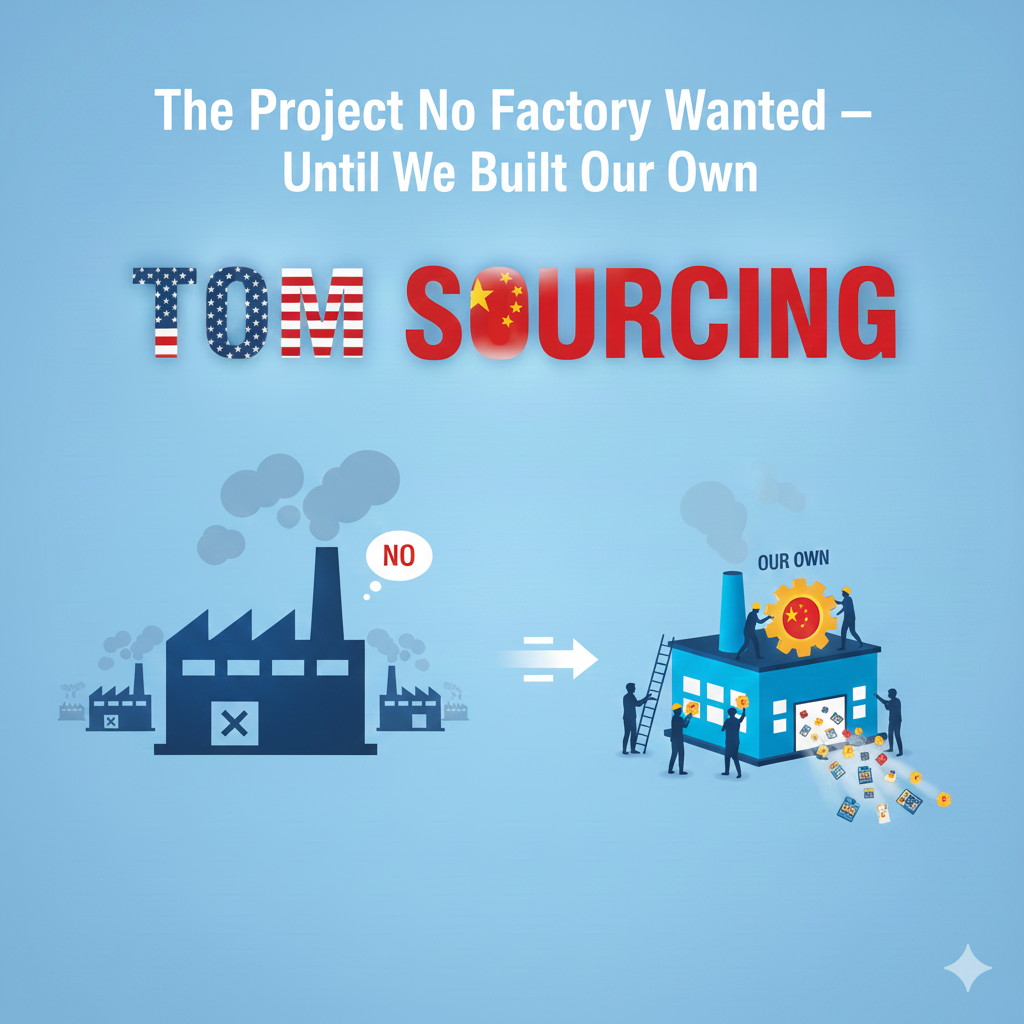
A sewing machine nobody wanted to produce.
A project rejected again and again across Jiangsu, Zhejiang, and Guangdong.
A project my former U.S. employer thought was “dead.”
But it became one of my earliest victories—and later, a defining case study for Tom Sourcing.
1. The Request That Looked Simple—But Wasn’t
The U.S. company we worked for back then wanted to launch a custom-designed sewing machine for DIY creators: lightweight, safer for beginners, and with a unique stitch function.
Simple on paper.
A nightmare in reality.
Most factories immediately asked:
- “What’s your annual quantity?”
- “How many models?”
- “Who will pay for the new tooling?”
When they heard the real numbers—initial 500 units, custom electronics, custom plastic housings, custom metal parts—they politely responded:
“Not suitable for us.”
Factories prefer predictable, stable, mass-volume projects.
This sewing machine required:
- Plastic injection molds
- Metal stamping
- Motors
- PCBA
- Tooling investment without guaranteed volume
- Specialized assembly line setup
For them, too much risk. Too little return.
But as sourcing manager, it was my job to find a path—if not through a factory, then around the entire system.
2. Mapping Out a Supply Chain That Didn’t Exist Yet
Since no single factory wanted the whole project, I developed a multi-supplier plan:
- Electronics + PCBA: Shenzhen
- Motor + mechanical assembly: Changzhou
- Plastic housing: Ningbo
- Metal internal parts: Suzhou
- Packaging: Shanghai
- Final assembly: TBD—because no one would do it
Instead of asking one factory to take everything, I broke it down piece by piece.
This reduced risk for suppliers and increased our flexibility.
But one problem remained: final assembly.
No factory wanted to build a custom sewing machine from scratch.
They didn’t have a line, and they didn’t want to change their workflow.
So we made a bold decision.
3. Building Our Own Small Assembly Line
We rented a small workshop space.
We brought in workers.
We wrote our own SOPs for:
- Assembly
- Testing
- Needle safety alignment
- Motor torque calibration
- Threading inspection
- Drop test for packaging durability
I coordinated everything:
- Designed the workflow
- Hired temporary labor
- Managed quality checks
- Tracked incoming materials
- Built the first 100 units by hand—with the team
It wasn’t glamorous.
But it worked.
And suddenly, something interesting happened.
4. When You Build It, the Factories Come to You
Once suppliers saw:
- Real samples
- Real testing equipment
- A real workflow
- A real purchase order
Attitudes changed.
Factories that said “不行” (not possible) a month earlier now said:
- “Maybe we can take over assembly.”
- “We can open a small line for you.”
- “Let’s discuss long-term cooperation.”
Why?
Because in China manufacturing:
Factories don’t like ideas.
Factories like evidence.
Once we created a feasible product—even by ourselves—the risk for suppliers dropped.
They could see the structure.
They could calculate costs.
They could forecast volume.
By the second production run, we already had two factories bidding to take over our assembly line.
5. The Turning Point: Scaling the Production
We ran full inspections on the first 500 units:
- Load testing
- Motor burn-in testing
- Needle safety checks
- Double QC for PCB stability
- Packaging carton drop tests
- Final functionality tests across all stitch modes
Return rate after launch?
Under 2%.
For a brand-new electromechanical product, that was a huge win.
And because we now had a proven product and stable demand, suppliers became motivated:
- Tooling upgrades
- Better packaging
- Faster lead times
- Lower MOQ
- Lower labor cost
- Higher consistency
The project went from “nobody wants it” to “everyone wants it.”
6. What This Project Means for Tom Sourcing Today
This early experience shaped the DNA of Tom Sourcing.
Today, we operate with:
- A real office
- Our own warehouse
- The ability to hire temporary workers for assembly, labeling, repacking, and QC
- 5 years of operating history
- Import-export license
- Full product development-to-shipment capability
And most importantly:
We don’t rely on suppliers to “believe” in a project.
We make the project believable through engineering, samples, and execution.
Sometimes a supplier says, “This project is too small.”
Sometimes they say, “Too difficult.”
Sometimes they say, “No existing line.”
But if we believe the customer has a real market opportunity—
we build the line, the system, or the sample ourselves.
Just like the sewing machine project.
That’s the TOM SOURCING difference.
7. The Final Result
Within 12 months, the project:
- Secured two competing suppliers
- Reduced unit cost by 18%
- Improved QC consistency
- Expanded into two new color variants
- Hit a reorder cycle every quarter
A project “no factory wanted” became one of the brand’s flagship products—sold in the U.S. and Europe.
And yes—this case is absolutely suitable to be presented as a Tom Sourcing success story.
Because the skills, mindset, and execution that made it possible
are the same engines powering our company today.
Leave a Reply